Six jailed for taking produce without paying: the grower's most fragile moment is the start of harvest
In Bozdoğan, Aydın, six people who bought olive oil, nuts and livestock from growers and failed to pay were caught in a simultaneous operation across three provinces on 15 September and jailed on 17 September. The method is a familiar one: the first purchase is paid in full, and once trust is established the large purchase is not. In the week harvest begins, growers have three concrete protections.
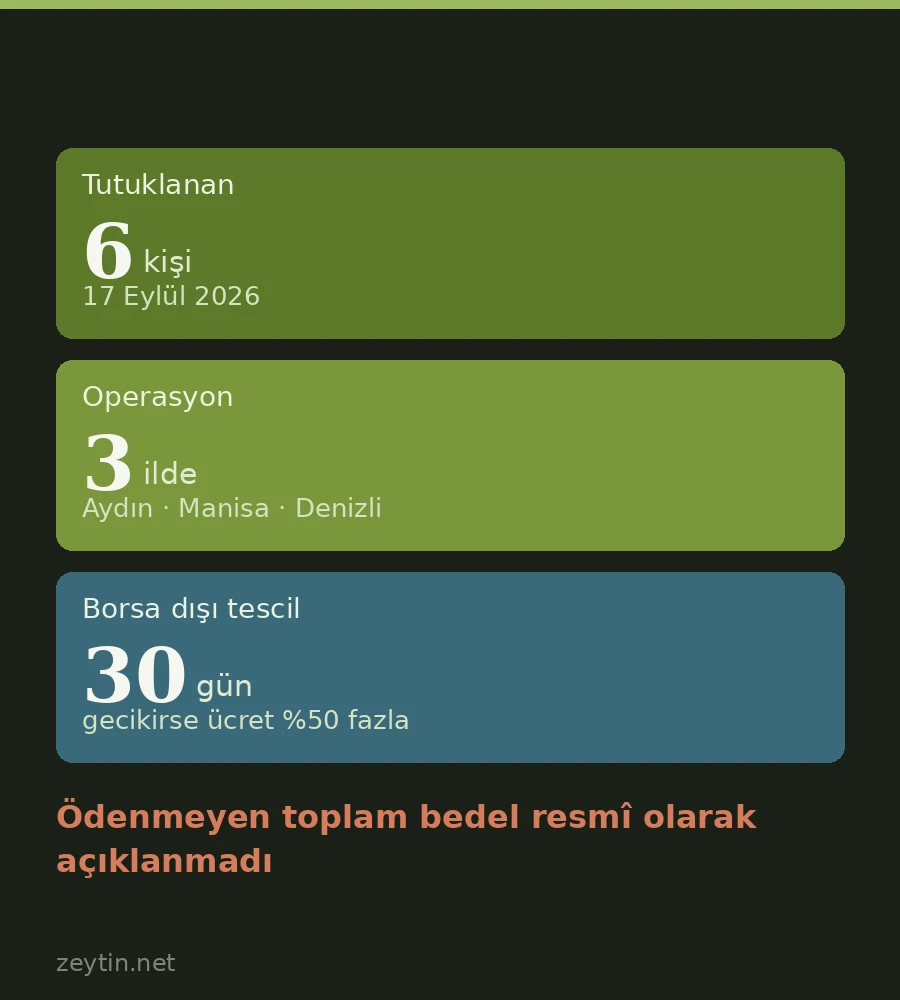
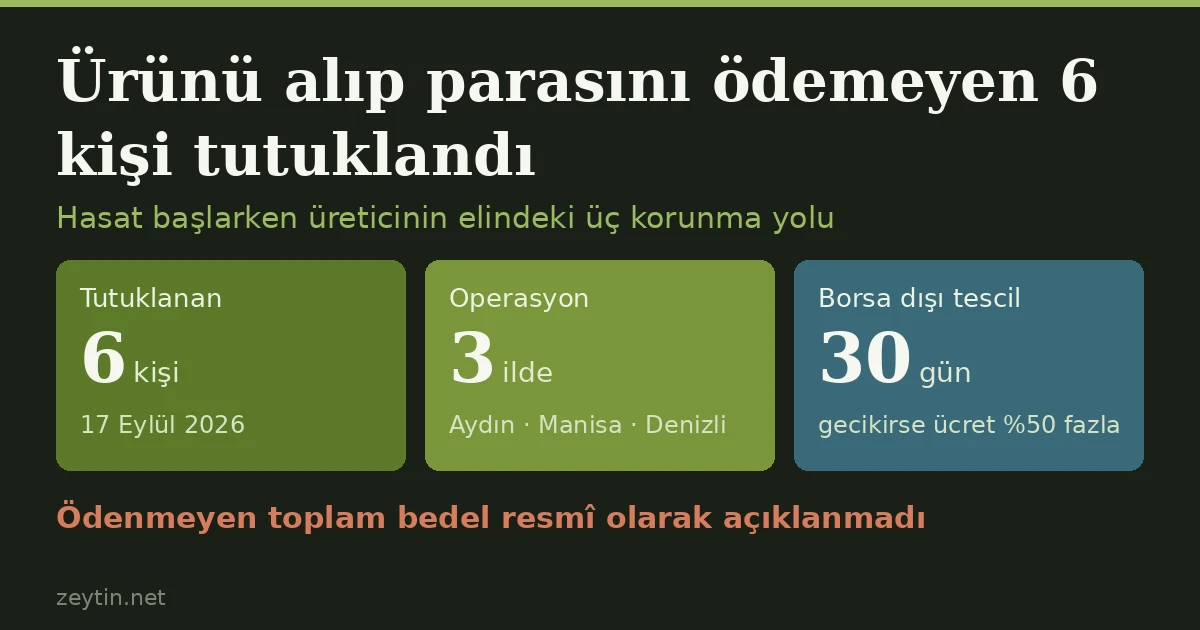
In Bozdoğan, a district of Aydın in western Türkiye, six people have been jailed for buying olive oil, nuts and livestock from local growers and failing to pay for them. Following an investigation, gendarmerie teams carried out a simultaneous operation in Aydın, Manisa and Denizli on 15 September; the suspects were detained and three mobile phones were seized. On 17 September all six were referred to the judicial authorities and remanded in custody.
The substance of the story is not the number of arrests. It is the method.
Why the method works
The pattern described is simple. On the first purchases the suspects paid for the goods in full. Within a village that buys a reputation quickly: here is the buyer who pays on the spot. On the purchases that followed, once trust had been established, payment was withheld under a series of excuses.
This is not opportunistic fraud. It is trust bought cheaply with a small first payment and cashed in on a far larger second one. The uncomfortable part for the grower is that the very thing that persuaded you — prompt payment, no haggling, no paperwork — is, in the case file, step one of the trap.
It is also worth noting why olive oil suits this pattern so well. Oil keeps, its value per unit is high, it travels in tins, and once it is unlabelled nothing about the product itself shows who produced it. A lorry-load of oil can change province overnight. The same is not true of a grove.
⚠ No official figure has been published for the total value of the goods taken or of the payments withheld. No amount is given here.
Why the timing matters
The second half of September is the point in the year when a grower has least cash and least patience. Harvest labour, fuel and milling fees are paid up front; the income has not yet arrived. In the same week we wrote about growers in Akköy, Didim, who paused the harvest for ten days because they considered the price too low. When price pressure and payment risk sit on the table together, the offer from a new buyer paying slightly above the going rate looks better than it is.
Enforcement in the region has been busy as well. We reported the other day on five separate adulteration operations in Aydın in the first half of September. The two case files are unrelated, but they point at the same gap: during harvest, olive oil moves hand to hand, quickly and largely off the record.
Three concrete protections
1. Register the sale with the commodity exchange. Under article 46 of Law 5174, purchases and sales of exchange-subject goods above a defined minimum quantity must be registered. Transactions carried out at a place designated by the exchange are registered the same day; transactions permitted to take place outside the exchange are registered within 30 days at the latest. Where registration is not completed in time without valid reason, the registration fee is collected with an additional 50%.
⚠ Registration is not a payment guarantee. What it produces is an official record of the sale with a date, a quantity and a price — which removes the defence that no such transaction ever took place.
2. Deposit the product in a licensed warehouse and turn it into a certificate. The scope of Law 5300 on the Licensed Warehousing of Agricultural Products, dated 17 February 2005, covers olives and olive oil alongside cereals, pulses, oilseeds, cotton, hazelnuts and dried apricots. When a product is deposited in a licensed warehouse, an electronic product certificate (ELÜS) is issued in the depositor's name. Trade can then take place through the certificate without the goods physically changing hands, and the certificate can be pledged as collateral for bank credit.
That matters because it separates the need for cash from the urgency of delivery. Needing money this week no longer forces you to hand the product to someone you do not know.
3. Sell to an institutional buyer. In cooperative and union purchasing the price is announced, the payment schedule is known in advance, and the counterparty is an institution rather than an individual. We have written separately about how purchase prices are set in the Marmara region and how payment is split into instalments. The money arrives in tranches rather than at once — but the risk of it not arriving at all is not the same as with an unknown private buyer.
The step before the sale: look the buyer up
All three protections concern the moment of sale. There is also a step before it. If the purchasing party is a registered trader, its record can be searched in the Turkish Trade Registry Gazette: whether the company exists, its registered title, its address and its authorised signatories are all public record. A name circulating by word of mouth in a village that has no counterpart in that record is not by itself evidence of wrongdoing — but it does mean there may be no legal person to answer to if a dispute arises.
⚠ It has not been disclosed whether the suspects in the Bozdoğan file bought through a registered company or as individuals; no assumption on that point is made here.
What to take from it
The Bozdoğan file will close. The method will not. In the first weeks of harvest, a new buyer moving from village to village who settles the first invoice immediately may not be offering a reference; that may simply be the first step of the method. The test is straightforward, and it is not how fast the first payment arrives. It is what document the second purchase is tied to.
Sources
- The operation, dates and arrests: the gendarmerie investigation conducted in Aydın and the custody decision issued after the suspects were referred to the courts on 17 September 2026.
- Registration obligation, deadlines and the late-registration penalty: article 46 of Law 5174 and the regulation on goods subject to commodity exchanges and the registration of their purchase and sale.
- Licensed warehousing scope and the electronic product certificate: Law 5300 of 17 February 2005 and the Ministry of Trade's published guidance on licensed warehousing.
- No total figure for the unpaid amount has been disclosed, so none is stated.
One rating per visitor; you can change yours at any time. Ratings are real reader votes — no seeded or default scores.
Related
 Article
The International Olive Council grows: Iraq joins, Brazil and South Africa apply
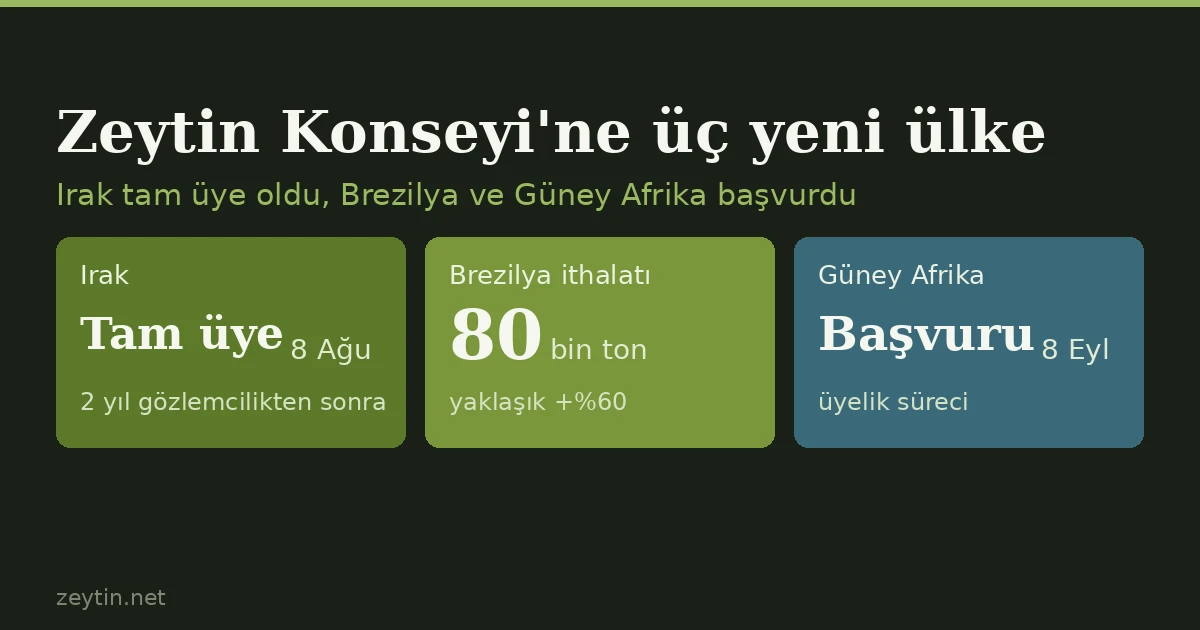
The International Olive Council (IOC) saw three developments in a month: Iraq became a full member on 8 August, South Africa submitted its membership request on 8 September and Brazil on 9 September. The expansion reflects olive oil's shift towards production and consumption areas beyond the Mediterranean.
Article
The International Olive Council grows: Iraq joins, Brazil and South Africa apply
The International Olive Council (IOC) saw three developments in a month: Iraq became a full member on 8 August, South Africa submitted its membership request on 8 September and Brazil on 9 September. The expansion reflects olive oil's shift towards production and consumption areas beyond the Mediterranean.
 Article
Five adulteration raids in 15 days in Aydın: 4,063 litres of oil, 7,922 empty tins
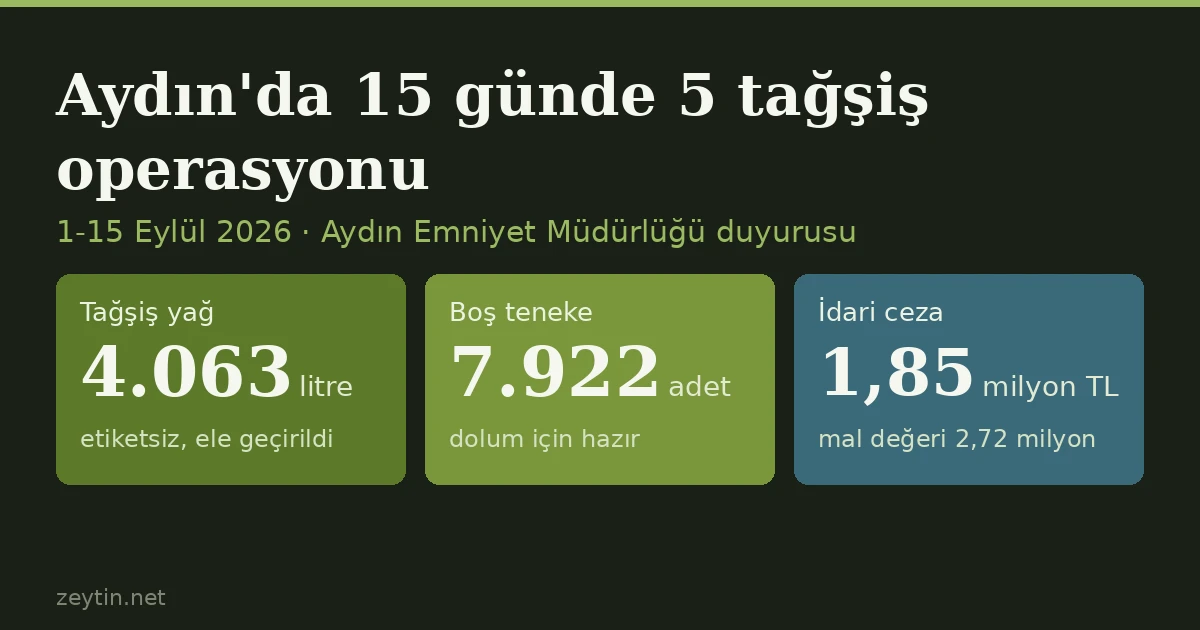
Police in Aydın say five operations between 1 and 15 September 2026 seized 4,063 litres of unlabelled adulterated oil and 7,922 empty tins. The goods were valued at about 2.72 million lira and the administrative fines totalled 1.85 million lira. The number of empty tins was nearly double the litres of oil seized.
Article
Five adulteration raids in 15 days in Aydın: 4,063 litres of oil, 7,922 empty tins
Police in Aydın say five operations between 1 and 15 September 2026 seized 4,063 litres of unlabelled adulterated oil and 7,922 empty tins. The goods were valued at about 2.72 million lira and the administrative fines totalled 1.85 million lira. The number of empty tins was nearly double the litres of oil seized.
 Article
Greece opens the season at €4: no scarcity in the Mediterranean, but pressure on price
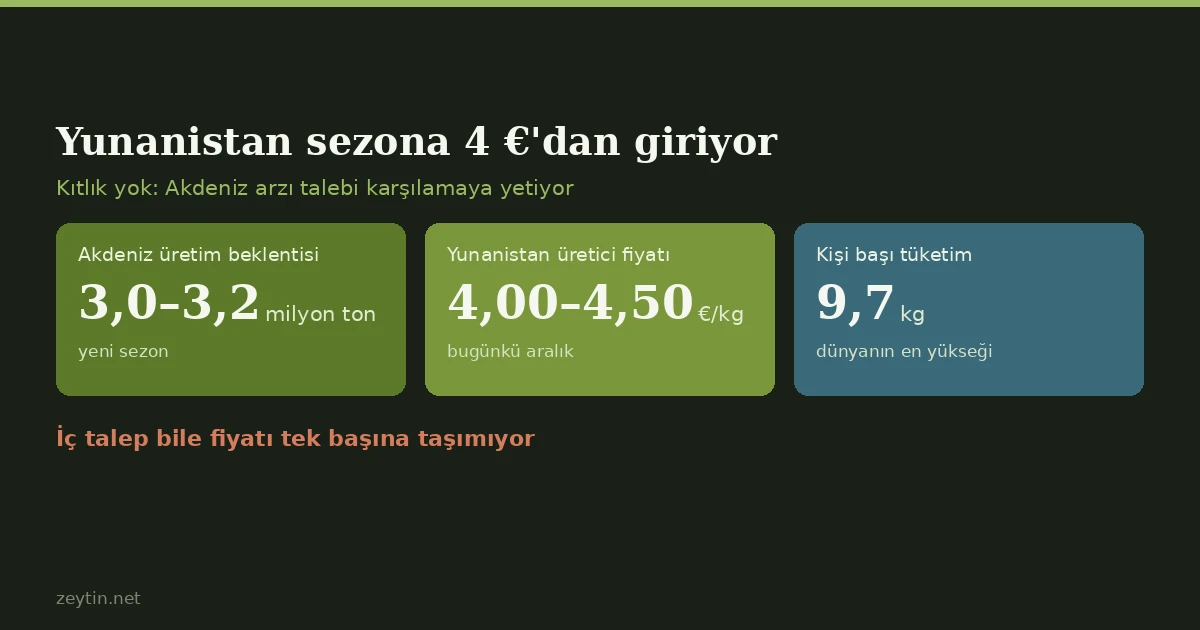
Manolis Giannoulis, president of the National Interprofessional Olive Oil Organization, expects the season to open at around €4 per kilogram. Mediterranean output is forecast at 3–3.2 million tonnes: no record, but enough to meet demand. The market is quiet, buyers are few, and costs plus North African imports keep the pressure on.
Article
Greece opens the season at €4: no scarcity in the Mediterranean, but pressure on price
Manolis Giannoulis, president of the National Interprofessional Olive Oil Organization, expects the season to open at around €4 per kilogram. Mediterranean output is forecast at 3–3.2 million tonnes: no record, but enough to meet demand. The market is quiet, buyers are few, and costs plus North African imports keep the pressure on.
 Article
Olive fruit fly warning before harvest in Aydın: check groves, spray only above the threshold
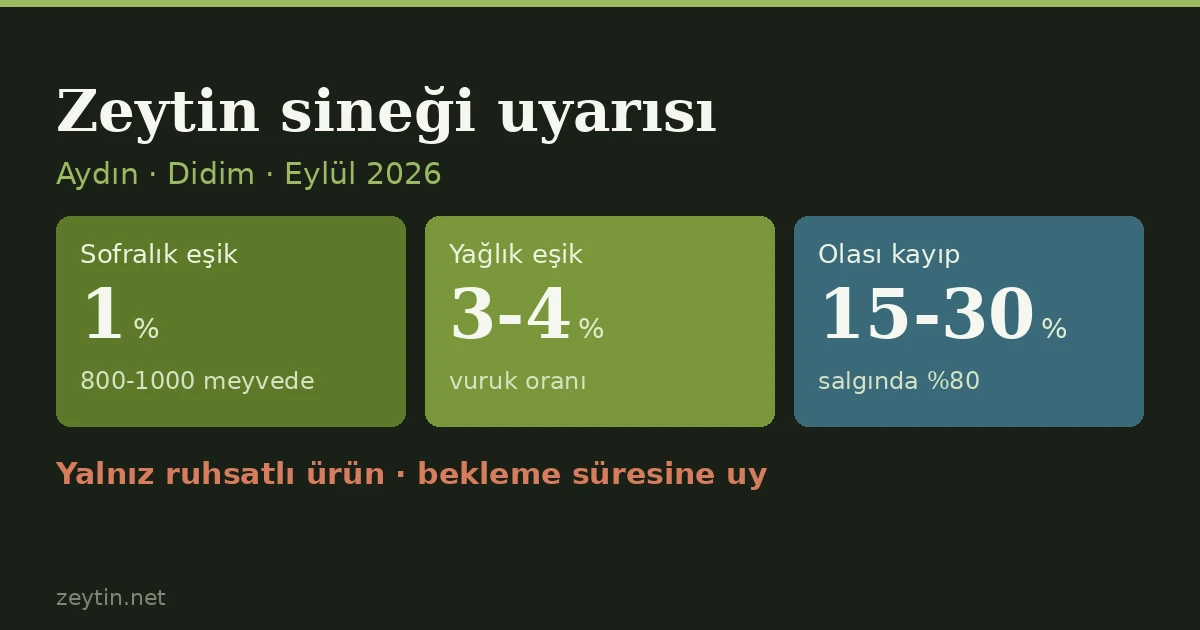
The Didim District Directorate of Agriculture and Forestry, together with the Aydın Provincial Directorate, has warned growers about the olive fruit fly ahead of the harvest. Growers were asked to check groves regularly, monitor pest density and, if needed, act only with products licensed for olives and at the right time. Fly pressure rising in autumn cuts both yield and oil quality.
Article
Olive fruit fly warning before harvest in Aydın: check groves, spray only above the threshold
The Didim District Directorate of Agriculture and Forestry, together with the Aydın Provincial Directorate, has warned growers about the olive fruit fly ahead of the harvest. Growers were asked to check groves regularly, monitor pest density and, if needed, act only with products licensed for olives and at the right time. Fly pressure rising in autumn cuts both yield and oil quality.