Olive leaf tea: how to make it and what the evidence says
The leaf carries oleuropein and other phenolics. Blood pressure trials show a modest effect, but all used standardised extracts — tea is not the same thing. Steeping, drying and cautions.
Olive leaf tea has become a widely recommended herbal infusion for blood pressure. This article treats two questions separately: what the leaf actually contains, and what the research shows. The answers are not the same — because almost all of the research has been done with standardised extracts, not with tea.
What is in the leaf
The olive leaf is the most phenol-dense part of the tree. Its principal compounds:
- Oleuropein — the characteristic and most abundant compound, and the same substance that makes raw olives unbearably bitter.
- Hydroxytyrosol and tyrosol — phenolic alcohols also found in olive oil.
- Verbascoside
- Apigenin-7-glucoside and luteolin-7-glucoside — flavonoids.
Commercial dried leaf extracts are generally standardised to 6–15% oleuropein. There is no single formulation standard in this field, so two products bearing the same name can differ substantially.
What the research shows
The blood pressure findings are positive but the effect size is modest. The numbers deserve to be given plainly:
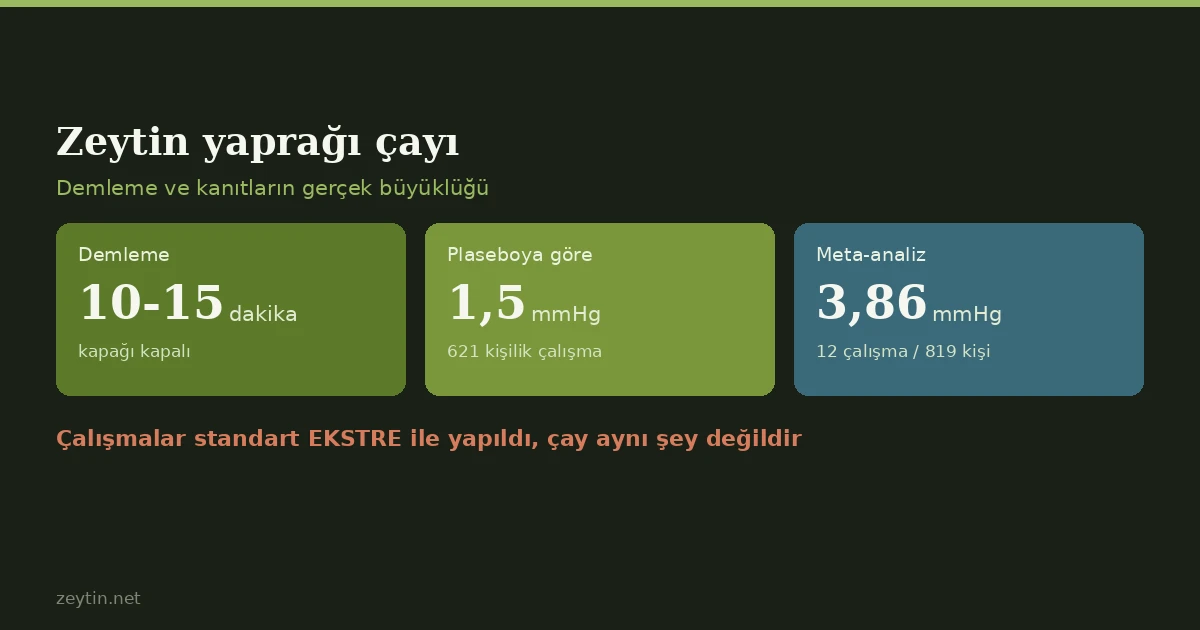
Large clinical trial. In a multicentre, double-blind, placebo-controlled trial of 621 participants, olive leaf extract reduced 24-hour systolic blood pressure by 6.4 mmHg against baseline — but by 1.5 mmHg against placebo. The gap between those two figures matters: most of the fall was seen in the placebo group as well.
Meta-analysis. Pooling 12 studies covering 819 participants, olive leaf extract lowered systolic blood pressure by an average of 3.86 mmHg and reduced triglycerides. No significant adverse effects were reported.
Doses used. Human studies have typically used 400 mg four times daily of an extract containing 7.2% oleuropein, over three months.
What this means is that olive leaf extract has a measurable but modest effect on blood pressure. For comparison, antihypertensive drugs typically achieve several times as much.
Tea and extract are not the same thing
This is the most important point in the article. Every study above used standardised extracts with measured oleuropein content. Home-brewed tea differs in three ways:
The dose is unknown. How much oleuropein ends up in a cup depends on the variety, the season the leaves were picked, how they were dried, the steeping time and the water temperature. There is no way to work out the tea equivalent of the 1,600 mg daily extract dose used in trials.
Extraction is partial. Oleuropein is water-soluble, but a single infusion does not transfer all of what is in the leaf.
There is no standard. Commercial tea bags rarely state their content.
Carrying the trial results directly across to tea is therefore not sound. Olive leaf tea can fairly be called a harmless herbal infusion; expecting a modest effect is reasonable, treating it as a substitute for medication is not.
How to gather and dry the leaves
Leaves are easiest to collect during pruning, preferably in spring — every pruning produces plenty of them.
1. Choose an unsprayed tree. Olive groves are treated against pests, and the leaf is where residue concentrates. Unlike the fruit, the leaf is not peeled, so make sure the tree you pick from has not been sprayed.
2. Rinse. Rinse in cold water to remove dust, drain and pat thoroughly dry.
3. Dry in shade. Spread the leaves in a single layer somewhere airy and out of direct sun for several days; sun-drying reduces phenolic content.
4. Check they are dry. They are ready when they crackle as you crumble them.
5. Store. Keep them in a closed, light-proof glass jar.
How to make it
The usual preparation:
1. Add 1 teaspoon of dried leaves to a cup (200–250 ml) of boiling water.
2. Steep covered for 10–15 minutes. The cover matters — volatile compounds escape with the steam.
3. Strain. Add lemon if you like.
The leaves are steeped, not boiled. Prolonged boiling increases bitterness and degrades some compounds.
Cautions
There is no authorised health claim. Olive leaf tea is credited online with many effects — lowering blood pressure, strengthening immunity, helping with infections. None of these is an authorised health claim under European Food Safety Authority (EFSA) rules. The only authorised claim concerning the olive belongs to olive oil polyphenols: contributing to the protection of blood lipids from oxidative stress, and it too depends on a specific quantity of hydroxytyrosol.
If you take blood pressure medication. The hypotensive effect of olive leaf extract can add to that of the drug, potentially lowering blood pressure too far. Consult your doctor before regular use.
Blood sugar. Some studies report effects on blood glucose; the same caution applies to those on diabetes medication.
Pregnancy and breastfeeding. There is insufficient safety data for these periods.
Amount. Not exceeding 2–3 cups a day is a reasonable limit. "It's herbal, it can't hurt" is not a sound principle — anything with an effect has a dose.
It is not a substitute for medication. The figures above show that even the extract cannot replace a drug. Abandoning treatment for diagnosed hypertension in favour of tea is risky.
Other uses of the leaf
- Fodder. Leaves left over from pruning are traditionally fed to sheep and goats around the Mediterranean.
- Extract. Sold as a supplement with standardised oleuropein content; the studies above used these products. Supplement use should involve your doctor.
- Compost. Leaves and thin prunings are a source of organic matter in the garden.
What comes from each part of the tree is gathered together in products of the olive.
Frequently asked
Does olive leaf tea lower blood pressure? Studies on extracts show a modest reduction (roughly 1.5–4 mmHg systolic versus placebo). Direct evidence for tea is weaker, because the dose is unknown.
Should it be drunk on an empty stomach? There is no comparative data. Those with a sensitive stomach may prefer it after meals.
Why is it bitter? Oleuropein — the same compound that makes raw olives inedible, and which brining is designed to remove.
Does it give the same benefit as olive oil? The compounds overlap in part, but the amounts and the matrix differ. See oleocanthal and polyphenols.
Can it replace eating olives? No. The fruit has its own nutritional profile — see the nutritional profile of olives and how many olives should you eat a day.
t; This article is for information and is not medical advice. Decisions about blood pressure, blood sugar or regular medication should be made with your doctor.
One rating per visitor; you can change yours at any time. Ratings are real reader votes — no seeded or default scores.
Related
 Article
Olive pollen allergy: the quiet cause of May to July
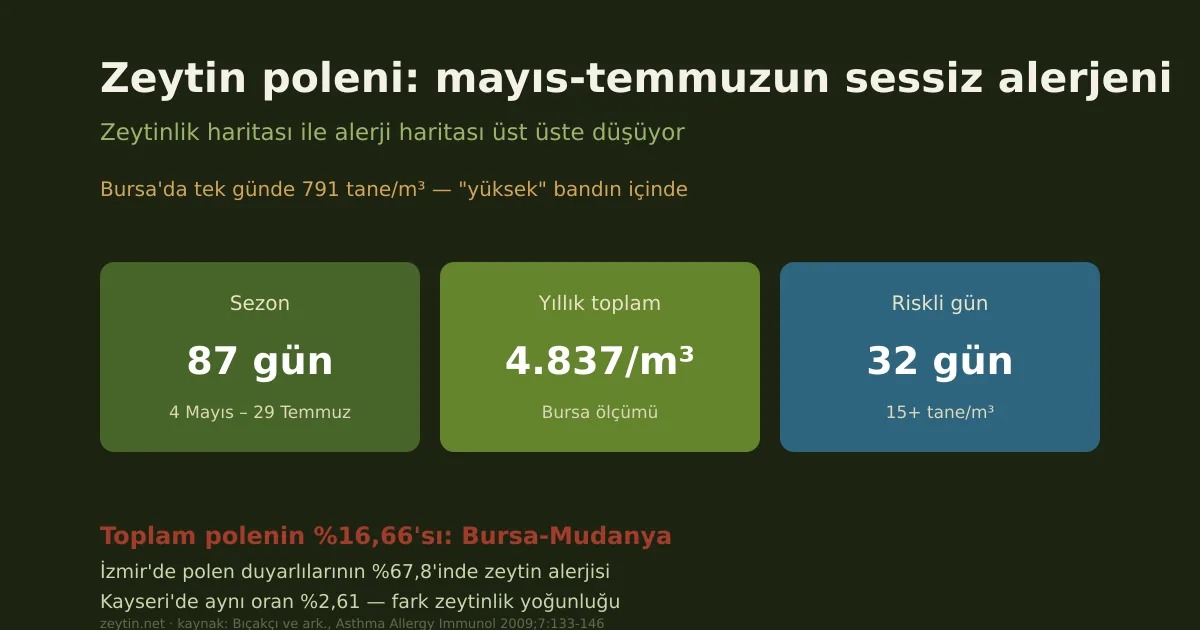
Olive pollen fills the air across western Türkiye from May to July. Bursa recorded 791 grains/m³ in one day over an 87-day season; 67.8% of pollen-sensitised patients in İzmir react to it.
Article
Olive pollen allergy: the quiet cause of May to July
Olive pollen fills the air across western Türkiye from May to July. Bursa recorded 791 grains/m³ in one day over an 87-day season; 67.8% of pollen-sensitised patients in İzmir react to it.
 Article
How many olives should you eat a day? Portions, salt and common questions
Calories, fat and salt in olives: what is a sensible daily amount? Based on nutrition data, without unauthorised health claims.
Article
How many olives should you eat a day? Portions, salt and common questions
Calories, fat and salt in olives: what is a sensible daily amount? Based on nutrition data, without unauthorised health claims.
 Article
Oleocanthal and Polyphenols
Why does a good extra virgin oil sting the throat? That sensation is not a flaw but the mark of a measurable compound.
Article
Oleocanthal and Polyphenols
Why does a good extra virgin oil sting the throat? That sensation is not a flaw but the mark of a measurable compound.
 Article
How Much Olive Oil a Day?
Olive oil being healthy does not make it unlimited. A practical look at portions, calories and the logic of replacement.
Article
How Much Olive Oil a Day?
Olive oil being healthy does not make it unlimited. A practical look at portions, calories and the logic of replacement.