How can you tell if olive oil is really organic? Four marks to check on the label
In Türkiye, "organic" is not a free adjective. Under the regulation, an organic olive oil label must carry the word 'Organik', the Ministry logo, the name and code of the authorised body and a certificate number. Plus: in-conversion products, the bio/eko ban, the EU logo, Türkiye's organic olive output and the shelf price gap.
When you see a bottle of olive oil marked "organic" on a Turkish supermarket shelf, the label itself tells you whether the word is marketing or a certified, inspected way of producing. In Türkiye "organic" is not a free adjective. Organic Agriculture Law No. 5262 and the Regulation on the Principles and Implementation of Organic Agriculture of 18 August 2010 spell out who may use the word, and under which conditions.
This article sets out what to look for on the bottle according to the regulation's labelling article, what the "in-conversion product" wording means, how much of Türkiye's olive crop is organic, and what the price difference looks like on the shelf.
The short answer: four marks
Under Article 29 of the regulation, the label of an organic product produced and sold in Türkiye must carry all of the following together:
| On the label | What it does |
|---|---|
| The word "Organik" (organic) | Declares that the product has been certified as organic |
| The Ministry's organic product logo | The official mark defined in Annex 10 of the regulation |
| Name, logo and code number of the authorised body | Shows who inspected and certified the producer; in Türkiye the codes begin with "TR-OT-" |
| Operator or product certificate number | Lets you trace the certificate itself |
If any of these is missing — especially the name and code number of the certification body — do not assume there is any inspection behind the word "organic". If in doubt, you can contact the body named on the label with the certificate number, and the provincial agriculture directorate can tell you whether that body is authorised by the Ministry.
What about "bio", "eko" and "natural"?
The regulation sets a very clear ban for products that are not organic: the words bio, biyo, eco, eko and org may not be used as a prefix, suffix or on their own in a way that gives consumers the impression of an organic product. The label and packaging design of a non-organic product may not imitate that of an organic one either. The rule applies to imported products as well.
So if you see a name like "Eko Olive Oil" or "Bio Extra Virgin" on a Turkish label without any certification details beside it, treat it as a warning sign. Words such as "natural", "village oil" or "no additives", on the other hand, do not mean organic; they make no binding statement about how the oil was produced. For the full list of binding and non-binding label terms, see our guide on how to read an olive oil label.
What does "organic agriculture in-conversion product" mean?
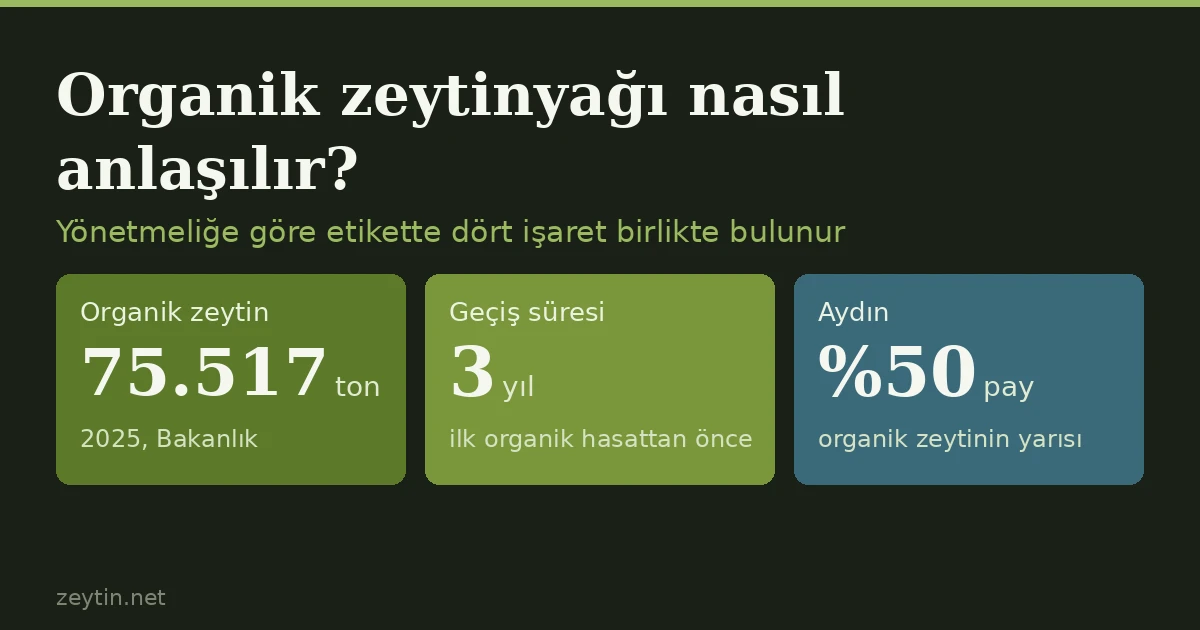
An olive grove does not become organic on the day it switches to organic methods. Under Article 7 of the regulation, perennial crops such as olives go through a three-year conversion period before the first organic harvest. The certification body can extend or shorten this period after looking at the land's history, but for perennial crops conversion can never be shorter than 24 months.
There is a separate label for produce harvested during those three years. Fruit harvested 12 months after the switch to organic methods may be sold with the wording "Organic Agriculture In-Conversion Product" (Organik Tarım Geçiş Süreci Ürünüdür). In that phrase the word "organic" must be in the same colour, size and typeface as "in-conversion" — in other words, "ORGANIC" cannot be printed large with "in-conversion" in small type. And the organic product logo may not be used on in-conversion products.
The distinction matters to growers: the cost of conversion is paid in these years, but the produce cannot yet be sold at the full organic price. We looked at where the real cost of conversion lies, using a side-by-side trial in the Aegean region, in our article on organic olive growing: a yield comparison.
Organic does not replace the quality grade
"Organic" describes a method of production, not a quality grade. Organic olive oil is subject to the same grades in the Turkish Food Codex as any other oil: extra virgin, virgin, riviera (a blend of refined and virgin oil) and the rest. The regulation states that the Food Codex labelling rules apply to organic products alongside the organic rules, so an organic bottle must still state its grade.
The practical consequence is simple. An organic oil made from badly harvested fruit, or fruit that waited too long before pressing, can have high acidity and taste defects. Organic certification controls the use of pesticides and fertilisers; it does not guarantee freshness or flavour. To tell the grades apart see extra virgin, virgin and riviera explained, and for the numbers that measure quality see what acidity means in olive oil.
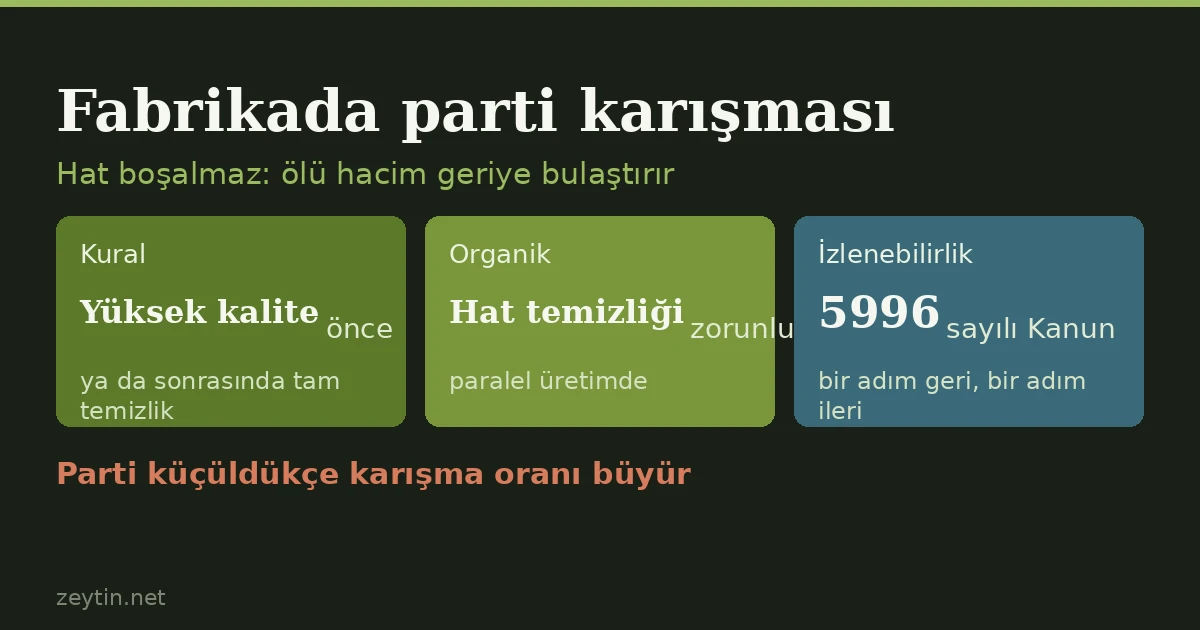
Organic inspection also covers the mill. Organic olives must not be mixed with conventional fruit on the same line, which is why line cleaning before an organic run is compulsory (do batches get mixed at the olive mill?).
Bottles sold in Europe carry a different logo
Organic products sold in the European Union carry the EU's leaf-shaped logo made of stars on a green background. Below the logo is the code of the control body; for countries outside the EU this code begins with the country abbreviation followed by "BIO". Next to the code the label states where the agricultural raw materials were farmed: "EU Agriculture", "non-EU Agriculture", or "EU/non-EU Agriculture" for a mix. So seeing "non-EU Agriculture" on an oil produced in Türkiye and sold in the EU is perfectly normal.
In the other direction, an organic product imported into Türkiye must be re-certified under the Turkish regulation before it can be sold with the Ministry's logo.
How much organic olive production is there in Türkiye?
When we add up the province-by-product tables of the Ministry of Agriculture and Forestry's Organic Agriculture, 2025 statistical bulletin, published on 1 June 2026, the picture for olives is as follows:
| Item | Farmers | Area (ha) | Production (t) |
|---|---|---|---|
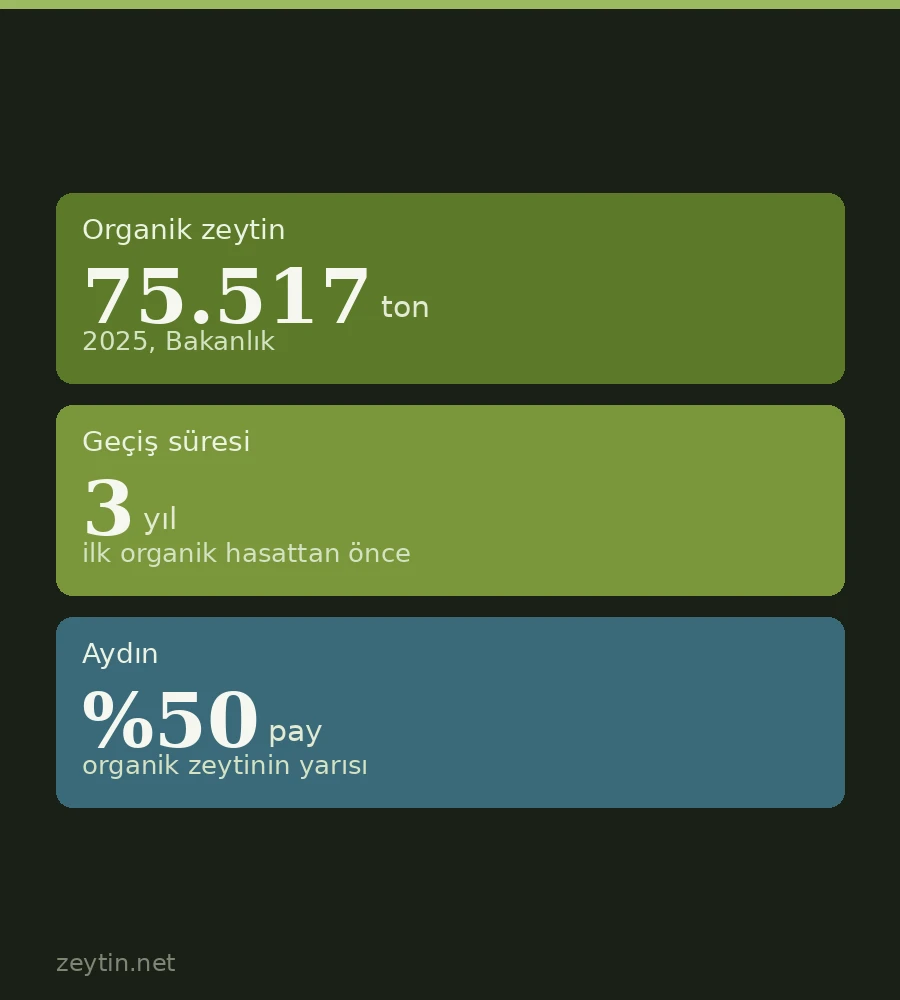
| Organic, 2025 | 5,229 | 29,604 | 75,517 |
| Organic, 2024 | 5,742 | 30,777 | 89,245 |
| In conversion, 2025 | 2,531 | 9,769 | 24,866 |
Source: Ministry of Agriculture and Forestry, Organic Agriculture 2025 bulletin, Tables 1, 2 and 6. Production is olives (table and oil olives together), not olive oil. The sum of the provincial rows is our calculation.
Half of Türkiye's organic olives come from a single province: Aydın produced 37,651 tonnes from 14,900 hectares farmed by 3,055 growers. It is followed by Balıkesir (11,922 tonnes), Muğla (10,211 tonnes), İzmir (5,724 tonnes) and Manisa (4,566 tonnes). Olives alone cover about 18 percent of Türkiye's 165,781 hectares of organic farmland.
For a sense of scale: the National Olive and Olive Oil Council estimated Türkiye's 2025-26 olive crop at 2.45 million tonnes. The 75,517 tonnes of organic olives are roughly 3 percent of that — about one in every thirty olives grown in the country comes from a certified organic grove.
The bulletin also shows the organic olive area shrinking slightly, from 30,777 to 29,604 hectares, while nearly 10,000 hectares are in conversion. The larger drop in organic tonnage, from 89,245 to 75,517 tonnes, may partly reflect the crop cycle rather than growers leaving organic farming: the national council's estimates put the 2024-25 olive crop at 3.6 million tonnes and the 2025-26 crop at 2.45 million.
How big is the price gap on the shelf?
The 24 extra virgin olive oils we tracked across seven supermarket chains on 19 October 2026 ranged from 249 to 880 lira per litre. Two of them were organic, both in 500 ml bottles:
- One brand's organic extra virgin oil sat on the same shelf as the same brand's non-organic extra virgin oil at the same price: 250 lira for 500 ml, or 500 lira per litre.
- The other organic oil was the most expensive on the list at 880 lira per litre. The same brand's non-organic one-litre extra virgin oil was selling for 359 lira at another chain.
Two examples are not enough to calculate a general "organic premium". But one point is clear: the price of organic oil depends on the brand and the bottle size, and small bottles already push up the price per litre (is a bigger pack of olive oil cheaper?). When comparing an organic oil, the price per litre and the same brand's conventional product are as worth checking as the logo.
Reading notes
⚠ The labelling rules are given as they stand in the 2010 regulation with its amendments from 2011 to 2020; legislation can change.
⚠ The organic production figures are the sum of the Ministry's province-by-product tables; olive oil volumes are not published separately.
⚠ Prices come from a single scan on 19 October 2026; two organic products are not enough to calculate a general price gap.
One rating per visitor; you can change yours at any time. Ratings are real reader votes — no seeded or default scores.
Related
 Article
How to Read an Olive Oil Label
Grade, harvest year, acidity, origin and bottling place: which statements on a label are binding and which are just marketing — with a quick checklist.
 Article
How to make olive oil at home: crushing, kneading, separating and realistic expectations
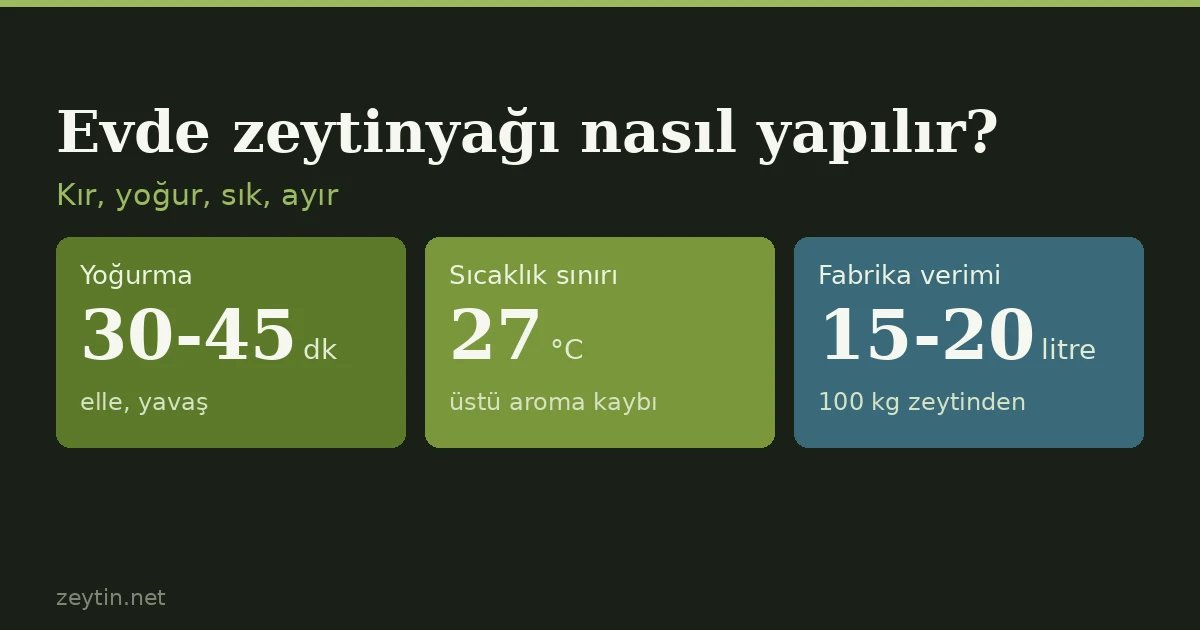
Pressing oil from a few kilos of olives at home is possible: the olives are crushed with their stones, the paste is kneaded, pressed and left until the oil separates from the water. But yield stays well below a mill's and quality is hard to protect. The steps, the equipment and the limits.
 Article
Do batches get mixed at the olive mill? Dead volume in the line and milling order
A mill line does not empty completely between batches: oil remains in the crusher, malaxer, decanter, separator and pipework. Part of the first oil out therefore comes from the previous batch. Why milling order is a rule, why organic certification requires line cleaning, and what a grower should ask at the mill.
 Article
Ödemiş Çekişte Olive Oil: a separate harvest window called “çakır”
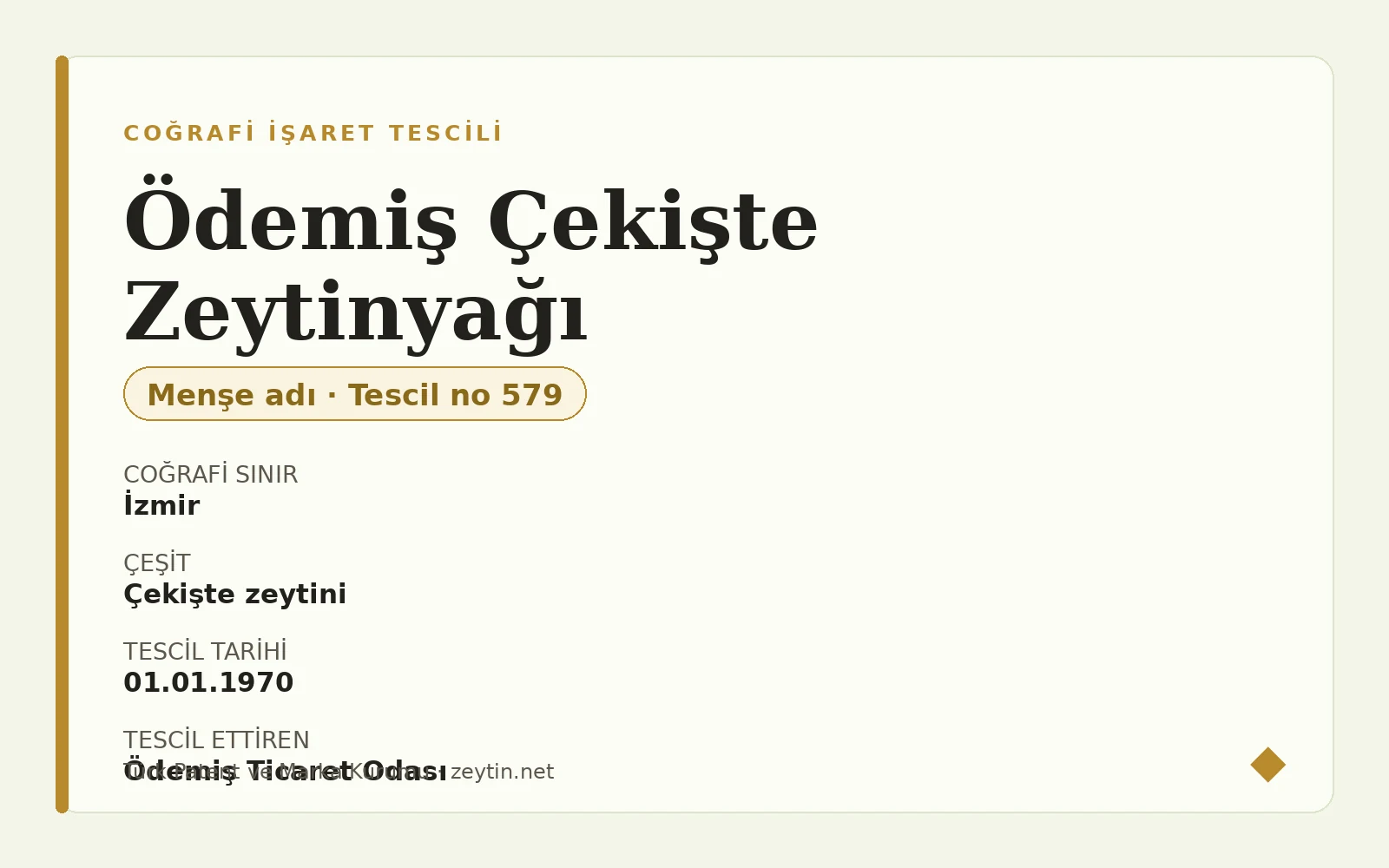
Registered in 2020. The certificate names two harvest windows: early (green, November-December) and “çakır” (green turning pink, mid-December to mid-January).