Does olive oil help with constipation? What the small controlled trials show
In a 140-person double-blind trial, two tablespoons a day of extra-virgin olive oil cut the constipation score from 11.27 to 3.47 in four weeks. What four trials did, what they could not show, and when to see a doctor.
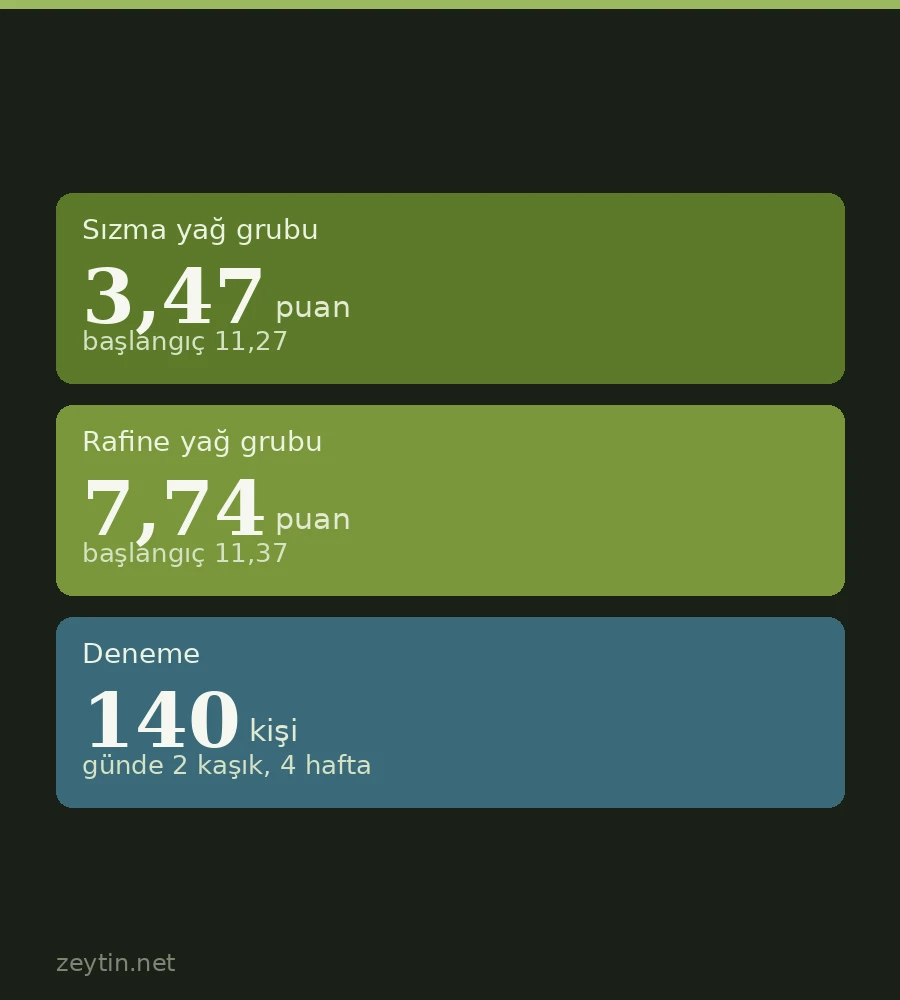
Short answer: In some small, controlled trials, olive oil reduced constipation symptoms. The most recent and largest is a double-blind trial of 140 people published in 2025: two tablespoons of extra-virgin olive oil a day lowered constipation scores markedly over four weeks. But all the trials are small, short and run in specific groups; olive oil is not a proven treatment or a routine recommendation for constipation. It is a finding at the "promising but not yet solid" level.
This article sets out what four trials did, what they found and what they could not show.
The figures
| Study | Who, how long | What was done | Finding |
|---|---|---|---|
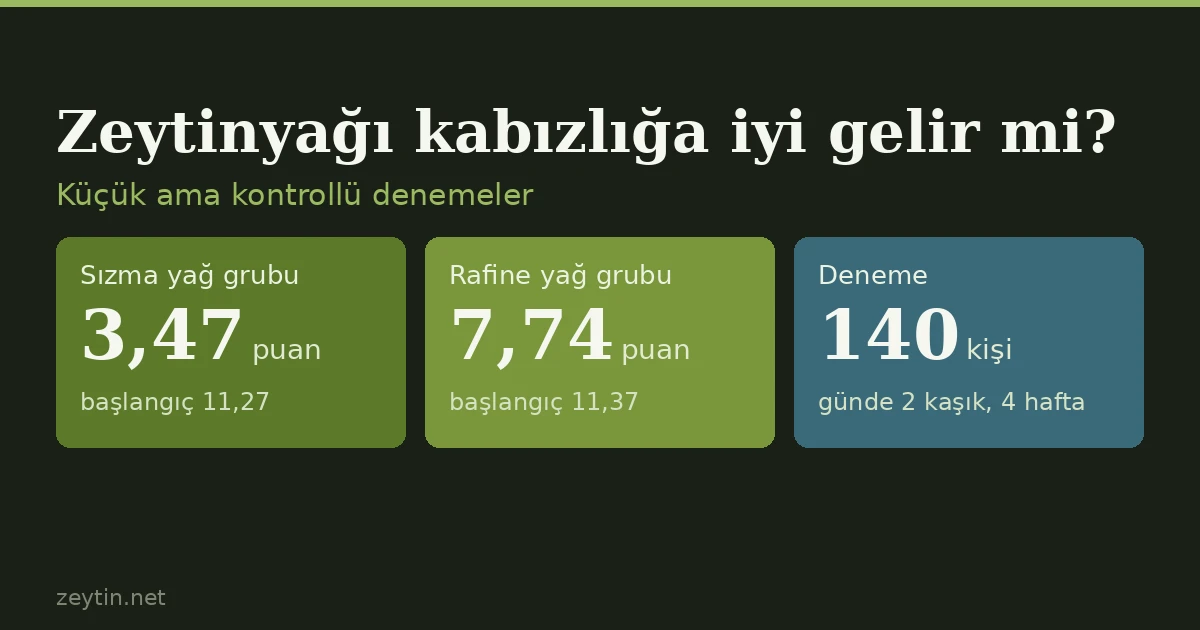
| Joukar et al. 2025, Caspian J Intern Med | 140 adults, chronic constipation, 4 weeks | 2 tablespoons a day of extra-virgin or refined olive oil | Rome III score fell from 11.27 to 3.47 with extra-virgin and from 11.37 to 7.74 with refined |
| Ramos et al. 2015, J Ren Nutr | 50 haemodialysis patients, 4 weeks | Olive oil, flaxseed oil or mineral oil, starting at 4 mL a day | Olive oil 10.3 to 3.2; mineral oil 10.5 to 4.1 |
| Faghihi et al. 2021, IJCBNM | 54 older adults in nursing homes, 5 days | Abdominal massage with extra-virgin olive oil, 15 minutes a day | Constipation score 5.62 to 2.06; control group 4.44 to 5.22 |
| Arman-Asl et al. 2021, Adv Exp Med Biol | 40 children aged 1-4, 4 days | Ointment with 85% olive oil or placebo ointment, applied to the abdomen | Stool frequency improved significantly more in the ointment group than with placebo |
Extra-virgin versus refined: the 140-person trial
In a study from Rasht, Iran, 140 adults whom a gastroenterologist had diagnosed with chronic constipation using the Rome III criteria were split in two: 70 received extra-virgin and 70 refined olive oil. Everyone took two tablespoons a day for four weeks, and the study was designed as double-blind.
The Rome III score (a higher score means more symptoms) fell from 11.27 to 3.47 in the extra-virgin group and from 11.37 to 7.74 in the refined group. On the Bristol stool scale, which rates stool form, the extra-virgin group also scored significantly higher than the refined group in weeks two, three and four (differences of 0.53, 0.78 and 1.14). The authors concluded that extra-virgin olive oil was more effective than refined.
There is an important limit: there was no comparison group that took no oil. Both groups received oil, and both improved. How much of the improvement even in the refined group came from the oil, how much from the feeling of being treated, and how much from time alone cannot be separated in this design. The evidence is "extra-virgin is better than refined", not "olive oil is better than doing nothing".
In dialysis patients: as effective as mineral oil
Ramos and colleagues split 50 constipated haemodialysis patients (mean age 51) into three groups: mineral oil (17 people), olive oil (16) and flaxseed oil (17). The starting dose was 4 mL a day and could be adjusted during follow-up. After four weeks the Rome III score fell from 10.5 to 4.1 with mineral oil, from 10.3 to 3.2 with olive oil and from 9.6 to 6.0 with flaxseed oil. The difference between groups was not significant (p = 0.15); five of the six constipation symptoms improved similarly in the mineral oil and olive oil groups. The authors report that olive oil was as effective as mineral oil in this patient group.
Here the comparison was with mineral oil, not placebo, and the numbers are very small. The causes of constipation in dialysis patients may also differ from those in the general population.
Abdominal massage and an ointment for children
Faghihi and colleagues divided 54 older people living in nursing homes in Shiraz into three groups: abdominal massage with olive oil, the same massage with water, and no extra intervention. Massage lasted 15 minutes a day for five days, and everyone continued their own medical treatment. On day six the constipation score fell from 5.62 to 2.06 in the olive oil group, while in the control group it rose from 4.44 to 5.22 (p = 0.006). This is a massage study, not one about eating oil; the water group was included to separate the effect of massage itself, but the abstract does not report that group's result separately.
In the pilot study from Mashhad, 40 children aged 1 to 4 had an ointment containing either 85% olive oil or 85% liquid paraffin (placebo) applied twice a day for four days. Stool frequency rose significantly more in the olive oil group than with placebo, and no adverse effects were reported. But again this is a product applied to the abdomen, and it is a pilot study.
What these trials do not show
- There is no large, long-term trial with a no-oil control. The largest has 140 people and the longest lasted four weeks.
- All come from specific settings. The results are from small groups in Iran and Brazil; the same result has not been shown under other dietary and medication conditions.
- The dose is not fixed. One gave two tablespoons a day, another an adjustable dose starting at 4 mL.
- Long-term outcomes are unknown. The abstracts say nothing about whether constipation returned afterwards.
- The abstracts give little on side effects. Only the children's study states that none were seen.
What to do about constipation
The first step in constipation is the general principles: a diet with fibre, enough fluid, movement and not putting off the urge to go. An adult who wants to try olive oil in addition to these would be following the best-known amount in the trials, two tablespoons a day. That is about 240 kilocalories (a tablespoon is about 119 kcal; the calculation is in our nutritional profile article), which anyone watching their weight should count. For amounts see how much olive oil a day, and for possible downsides does olive oil have downsides.
See a doctor rather than experimenting if there is blood in the stool, unexplained weight loss, severe or worsening abdominal pain, or constipation that starts suddenly or lasts more than a few weeks. In children, in pregnancy and in people with chronic illness, especially kidney disease, any use should follow a doctor's decision. Rubbing olive oil on the abdomen or massaging it does not remove the need to find the cause of the constipation.
Summary
In all four small controlled trials, symptoms eased in the groups that were given or rubbed with olive oil, and in the most recent study extra-virgin olive oil did better than refined. But the lack of a no-oil comparison group, the small samples and the short duration mean this evidence does not support saying "olive oil treats constipation". The most honest summary is that it is a support that can be tried after talking to a doctor, but one that is not yet well proven.
t; This article is general information; consult your doctor for diagnosis and treatment.
One rating per visitor; you can change yours at any time. Ratings are real reader votes — no seeded or default scores.
Related
 Article
What Are Green Olives? What Are Their Benefits?
What green olives are, what they contain and how many calories. Fat, fibre, vitamin E and polyphenols — and the salt that portion talk must not skip.
 Article
What are the benefits of olive oil?
Authorised claims, topics still under research and unproven claims kept apart — including the EFSA claim and PREDIMED.
 Article
Which olive is healthiest?
In olives the health difference comes from curing and salt, not the variety: nutrition, salt content and green vs black.
 Article
Can you put olive oil on your skin? What the evidence says
You can, but studies suggest regular use may weaken the skin barrier; it is not advised for eczema or babies and gives no sun protection.