3,200 trees and 72 varieties on 14 hectares of stone: the cooperative turning Dalmatian karst into groves
Some 100,000 hectares of karst lie neglected in Dalmatia while all of Croatia has 20,000–24,000 hectares under olives. In Desne a veterans' cooperative has grown 3,200 trees of 72 native varieties on 14 hectares of rock — a grove that doubles as a natural laboratory for climate resilience.
In the Dalmatian hinterland the landscape is always the same: vast expanses of grey stone, scrub and thorny brush. Silence prevails among the abandoned dry-stone walls. An estimated 100,000 hectares of karst fields and slopes lie neglected across Dalmatia, while all of Croatia has only 20,000 to 24,000 hectares under olive cultivation.
One project shows that ratio can be turned around: a veterans' cooperative in Desne, in the municipality of Kula Norinska in southern Dalmatia.
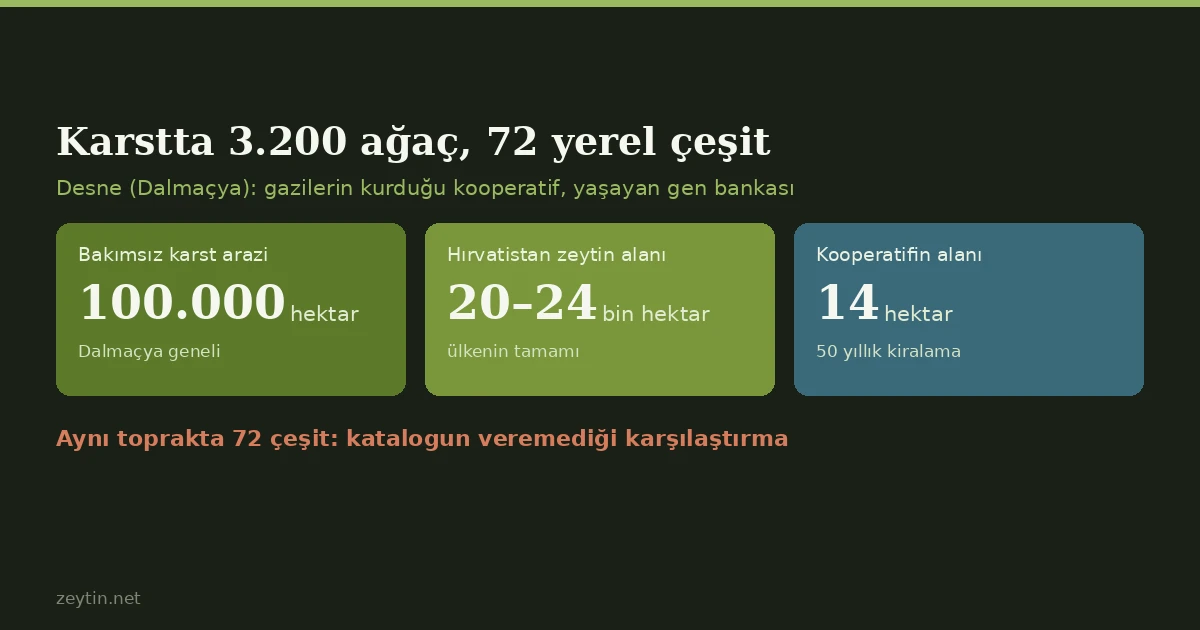
The numbers
| Item | Value |
|---|---|
| Neglected karst land in Dalmatia | ~100,000 ha |
| Croatia's total olive area | 20,000–24,000 ha |
| Area worked by the cooperative | 14 ha |
| Concession term (Croatian Forests) | 50 years |
| Olive trees | 3,200 |
| Native varieties | 72 |
| Altitude range | 50–420 m |
| Gradient (in places) | over 40% |
| Counties it serves as reference centre | 7 |
They exchanged weapons for tools
The Modro Zelena production and service cooperative began work in late 2004 on 14 hectares of karst leased from Croatian Forests under a 50-year concession. Its founders were members of an association of volunteers and veterans of the Croatian War of Independence.
The hard, exposed karst was cleared by hand at first. Today the same ground carries 3,200 olive trees and 72 native varieties; the grove drops from 420 metres to 50, gradients exceed 40 percent in places, and fields of lavender surround the trees. The Ministry of Croatian Veterans has designated the cooperative a reference centre for seven coastal counties.
The cooperative's secretary, the agronomist Nebojša Jerković, defines what the site is: "Our collection in Desne is not merely an experimental olive grove; it is a living gene bank and a form of insurance for Croatian olive growing."
Seventy-two varieties on one soil: a natural laboratory
That is where the grove's real value lies. Growing 72 varieties on the same rocky soil under the same sun makes it possible to see, comparably, which trees withstand climatic extremes and which begin to struggle.
The findings are striking:
- Oblica — the region's traditional variety, confirming its title as queen of the karst with resistance to drought, cold and the bora wind.
- Lastovka and Drobnica — withstand months of heat without rainfall.
- Levantinka — despite its high reputation, among the first to show stress; without irrigation at critical stages it cannot reach its potential.
- Paštrica and Buharica — remarkably consistent yields and disease resistance.
Jerković's conclusion is direct: "Our native varieties already provide a biological response to the climate crisis. These old varieties have spent centuries adapting to our microclimates. Our task is to evaluate those genes scientifically and use them when establishing new groves instead of blindly copying solutions from elsewhere."
So why is it not spreading?
If the model works, the question is why similar groves are not spreading across Dalmatia. Jerković names three barriers.
Bureaucracy. Unresolved ownership, small and scattered parcels, and chronic discrepancies between cadastral records and land registries turn access to state land into a years-long ordeal. "We often spend more time and energy resolving paperwork than preparing the land and establishing the grove itself."
Technical and financial risk. Preparing karst for cultivation is closer to mining than to farming: heavy machinery is needed to break the rock, create planting sites, protect the scarce fertile soil from erosion, build access roads and secure water. After that initial outlay come several years of maintenance without income, until the trees reach commercial production. Because EU funds are often paid only after an investment is completed, young farmers carry the whole risk at the outset.
The market. The third and most severe barrier is a market shaped by import interests and large retail chains. "A domestic producer who invests in karst land, native varieties and organic cultivation simply cannot compete on price with mass-produced imported oil. Retail chains prioritise the lowest purchasing price, while origin and the work of local farmers remain secondary."
A three-step proposal
Jerković's proposal to government and investment funds has three steps:
1. A karst registry. Not to cultivate every natural area, but to identify parcels that can be brought into production without environmental harm. Then consolidate them, resolve their legal status and offer them on long leases of 30 to 50 years. Establishing permanent crops on land without secure tenure makes little sense.
2. A national karst restoration programme within the Common Agricultural Policy strategic plan, providing advance payments and affordable long-term loans to young farmers, sustained through the first years when there are costs but no harvest income. As Jerković puts it: "The government cannot simply hand a farmer bare rock and say, 'You are on your own.'"
3. Second-tier cooperatives — professionally managed structures that bring cooperatives together. He cites Spain's Dcoop and Grupo Jaencoop and Italy's C.A.B. Terra di Brisighella as examples.
Seen from Türkiye
All three barriers are familiar. Fragmented parcels, ownership and cadastral mismatches, the years between investment and income, and price pressure from retail chains appear under the same headings in our piece on structural problems.
But the transferable part is the second one: using native varieties as climate insurance. Türkiye's inventory of native olive varieties is wider than Croatia's; in our variety catalogue the drought and cold behaviour of each is set out separately. What is missing is not the number of varieties but comparative measurement under identical conditions: a grove that plants 72 varieties in the same stone and observes them in the same year answers a question no catalogue can.
What to watch
Whether karst restoration enters Croatia's Common Agricultural Policy strategic plan, and whether the legal framework for long leases is settled. Without security of tenure the model cannot be repeated.
One rating per visitor; you can change yours at any time. Ratings are real reader votes — no seeded or default scores.
Related
 Article
Orhangazi olive oil starts on the road to geographical indication, with samples to be tested for acidity and polyphenols
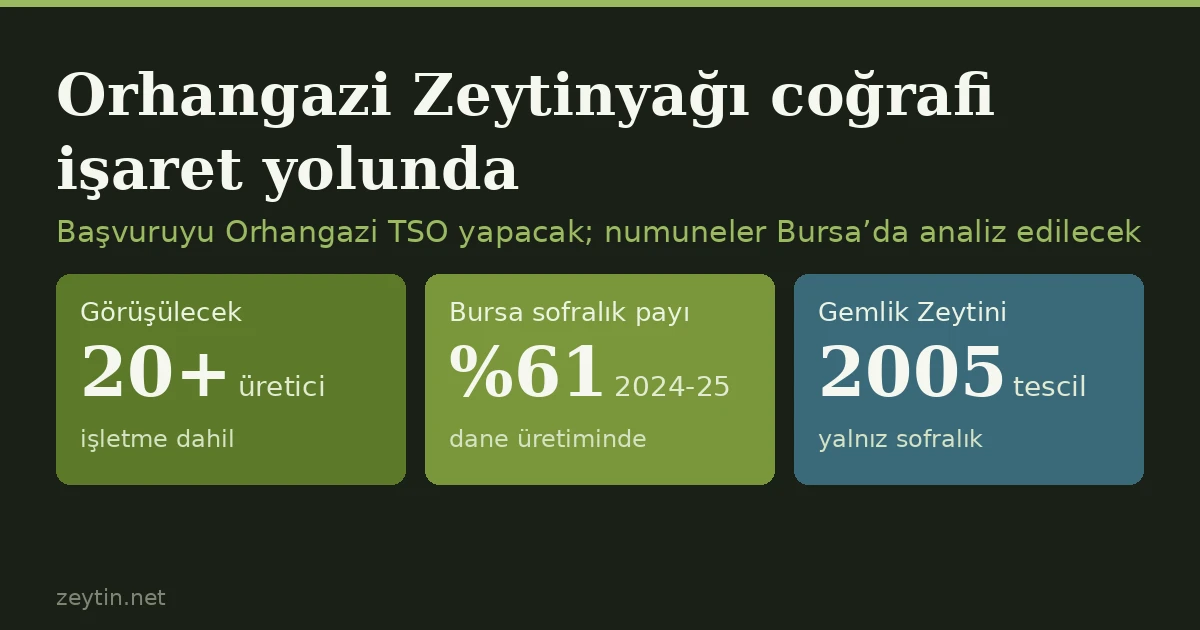
The Orhangazi Chamber of Commerce and Industry has begun preparing a geographical indication application for "Orhangazi Olive Oil". More than 20 producers will be consulted, samples tested in Bursa and the influence of the Lake İznik basin studied. The area's Gemlik Olive registration covers only table olives.
Article
Orhangazi olive oil starts on the road to geographical indication, with samples to be tested for acidity and polyphenols
The Orhangazi Chamber of Commerce and Industry has begun preparing a geographical indication application for "Orhangazi Olive Oil". More than 20 producers will be consulted, samples tested in Bursa and the influence of the Lake İznik basin studied. The area's Gemlik Olive registration covers only table olives.
 Article
Gaza's olive report: 150,000 trees left of two million, production down 87.5%
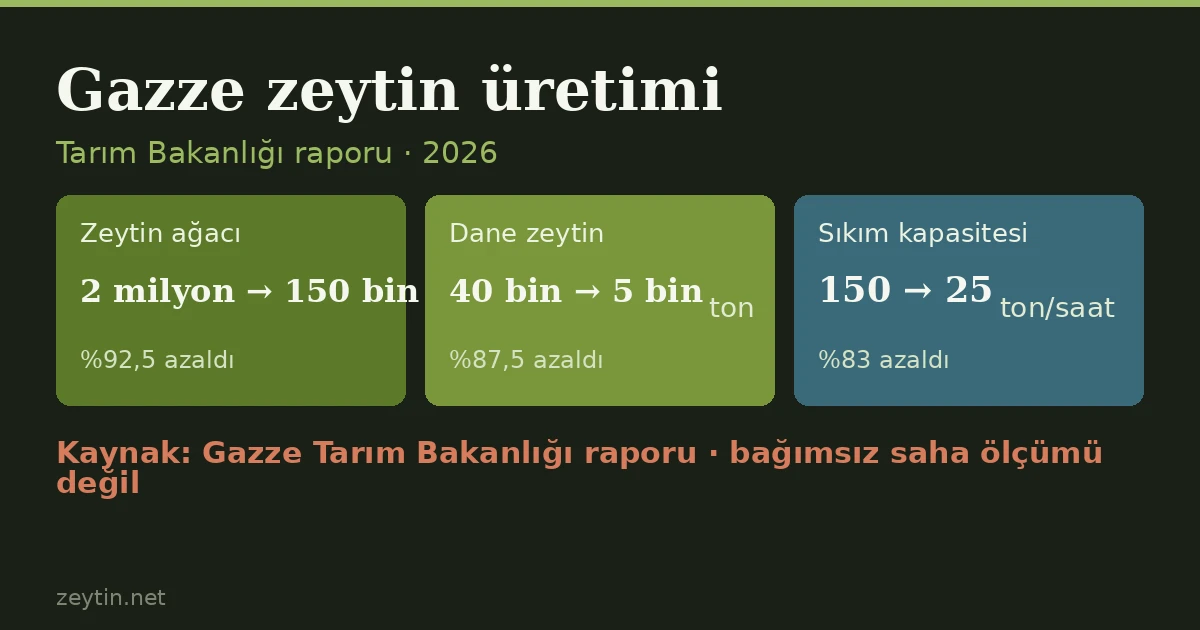
According to a report from Gaza's Ministry of Agriculture, olive groves have shrunk from 50,000 dunums to 5,000 and the olive crop from 40,000 tonnes to 5,000. The loss is not confined to the grove: milling capacity has fallen from 150 tonnes an hour to 25, and the number of growers from 20,000 to 1,000.
Article
Gaza's olive report: 150,000 trees left of two million, production down 87.5%
According to a report from Gaza's Ministry of Agriculture, olive groves have shrunk from 50,000 dunums to 5,000 and the olive crop from 40,000 tonnes to 5,000. The loss is not confined to the grove: milling capacity has fallen from 150 tonnes an hour to 25, and the number of growers from 20,000 to 1,000.
 Article
Two pressures before the harvest: costs and 100,000 tonnes carried over
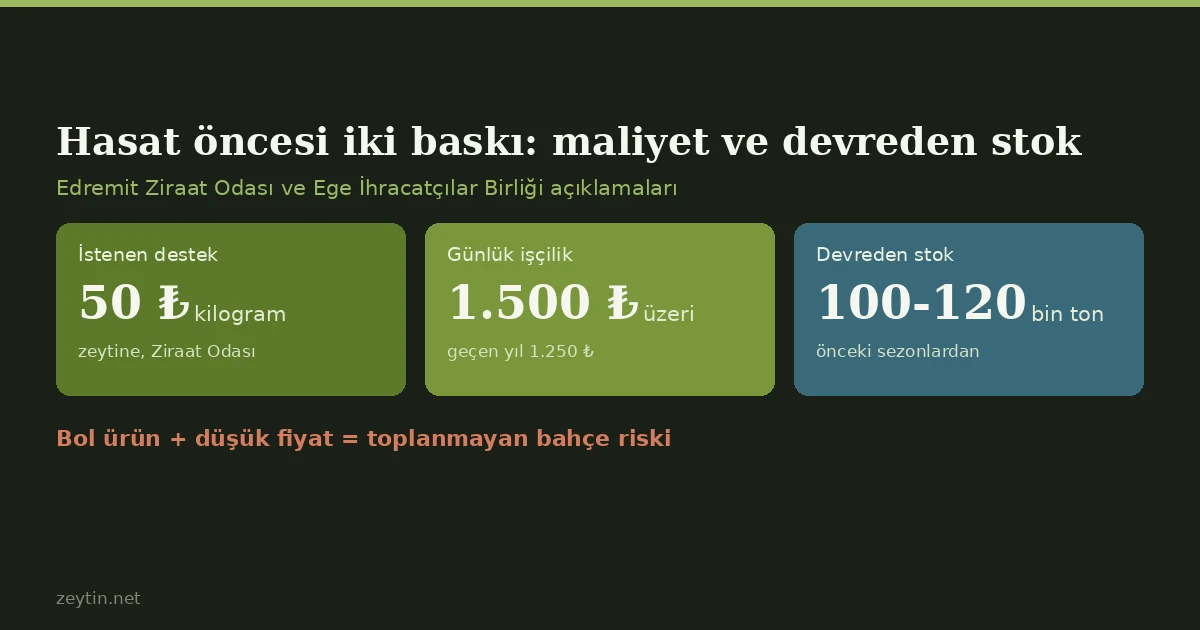
The chamber of agriculture wants 50 lira per kilo; daily labour has passed 1,500 lira. Exporters report 100,000-120,000 tonnes carried over from previous seasons.
Article
Two pressures before the harvest: costs and 100,000 tonnes carried over
The chamber of agriculture wants 50 lira per kilo; daily labour has passed 1,500 lira. Exporters report 100,000-120,000 tonnes carried over from previous seasons.
 Article
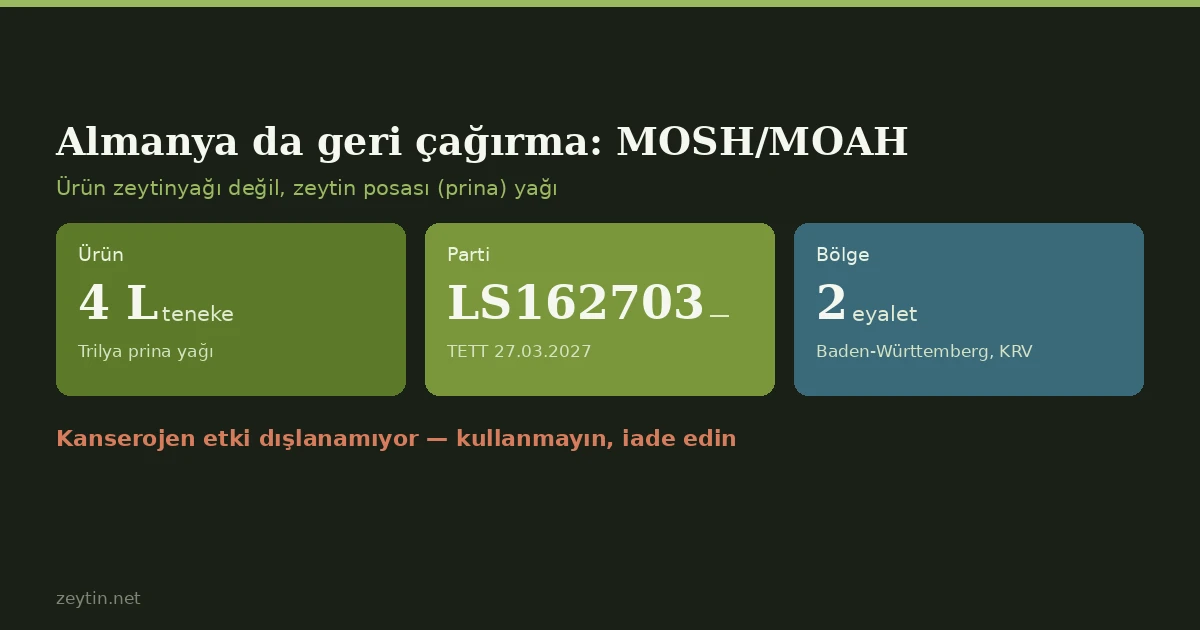
Recall in Germany: MOSH/MOAH in pomace oil — not olive oil
Germany's official food safety portal has recalled a 4-litre pomace oil sold in Turkish shops. The product is not olive oil but olive pomace oil; we explain the difference and what MOSH/MOAH are.
Article
Recall in Germany: MOSH/MOAH in pomace oil — not olive oil
Germany's official food safety portal has recalled a 4-litre pomace oil sold in Turkish shops. The product is not olive oil but olive pomace oil; we explain the difference and what MOSH/MOAH are.