Can olive leaves be used as animal feed? Do sheep and goats eat them, and are they harmful?
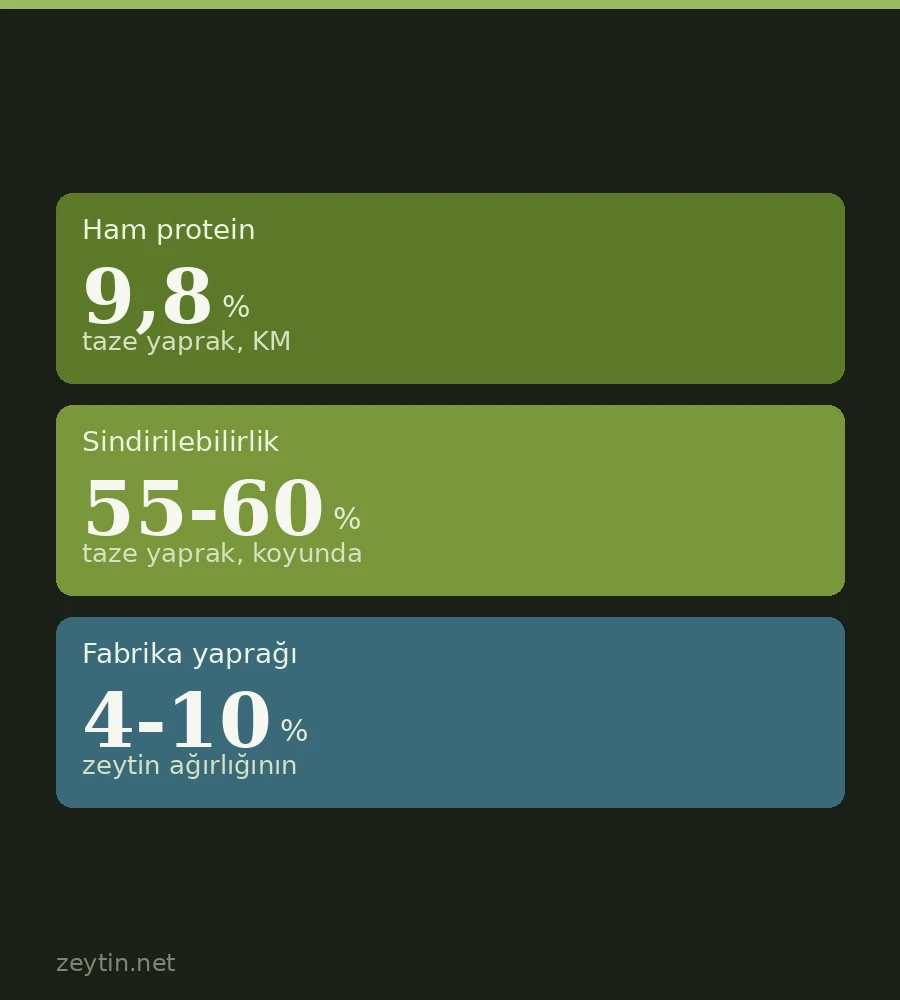
Olive leaves are a fibrous roughage eaten by sheep, goats and cattle: crude protein 8-12% of dry matter, NDF 46-53%. In sheep, fresh leaves are 55-60% digestible, leaves from chopped branches only 15-40%. Leaves sprayed with copper fungicides pose a poisoning risk to sheep.
Short answer: yes, olive leaves are a roughage that ruminants can use, and sheep, goats and cattle all eat them. But they are not good-quality forage: they are fibrous, low in protein and hard to digest. The main risk is not the leaf itself but what has been sprayed on it. Leaves treated with copper fungicides are a serious hazard for sheep, the species most sensitive to copper.
Feedipedia, the FAO-backed feed database, records that olive forage is relished by cattle, sheep, goats and camels. So the real question is not whether animals will eat it, but how much it is worth as feed and what to watch out for.
How many leaves are there?
Leaves come from two places: pruning and harvest. According to the review by Molina-Alcaide and Yáñez-Ruiz (2008), as cited in a 2024 study by Göncü and Kaya of Atatürk University, each olive tree drops about 25 kg of leaves a year across the harvest and pruning seasons. Feedipedia notes that leafy stems make up half of the pruning biomass.
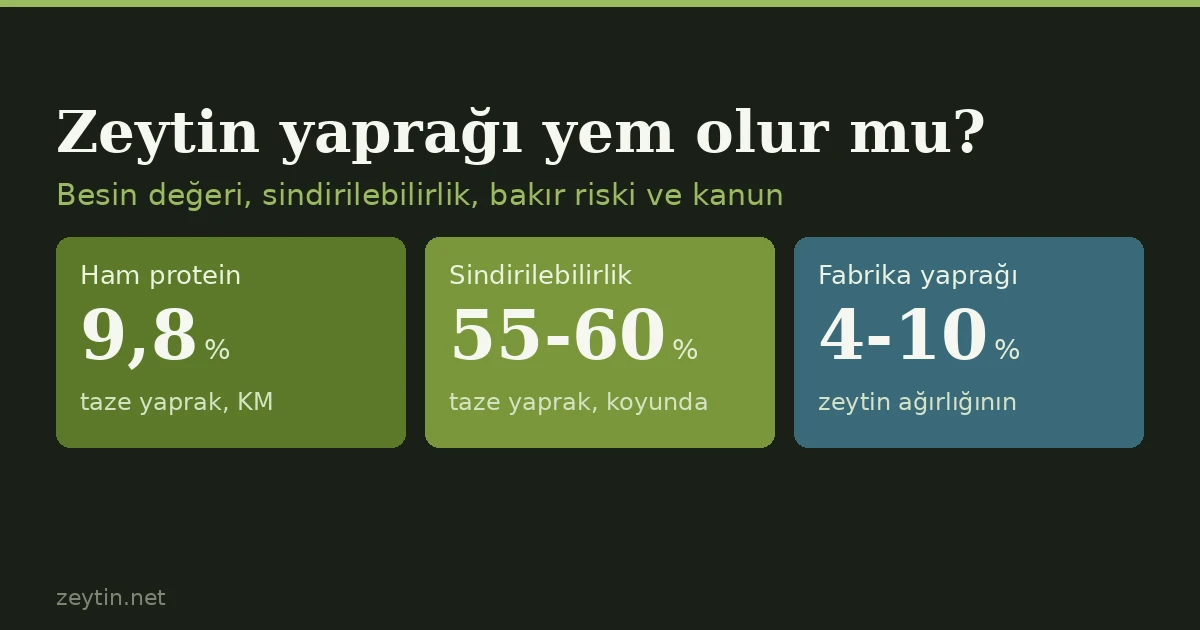
At the mill, a 2025 study by Ammar and colleagues from the University of Carthage in Tunisia reports that the leaves, twigs and debris separated from the fruit during mechanical harvesting and milling amount to 4-10% of total olive weight. Roughly speaking, every tonne of olives brings in 40-100 kg of leaves and debris. We covered the total volume of pruning residue in our article on olive pruning biomass.
Nutritional value: measured tables
| Measure | Fresh leaves | Dry leaves and twigs | Leaf silage | Milas, shade-dried |
|---|---|---|---|---|
| Dry matter (as fed) | 50.1 | 89.8 | 77.1 | 90.37 |
| Crude protein | 9.8 | 7.8 | 12.2 | 11.83 |
| NDF (cell-wall fibre) | 46.1 | 52.5 | — | 48.67 |
| ADF | 34.1 | 38.7 | — | 36.21 |
| Lignin (ADL) | 20.1 | 17.9 | — | 24.32 |
| Ether extract (fat) | 6.3 | 4.6 | 7.9 | 5.61 |
| Ash | 9.0 | 7.2 | 8.4 | 4.69 |
| Condensed tannins (g/kg DM) | 15.0 | 7.0 | — | 10.6 |
| Organic matter digestibility (%) | 56.9 | 32.7 | 47.5 | — |
The first three columns are averages from the FAO Feedipedia tables; the fourth is the Milas sample of Göncü and Kaya (2024). They were measured in different laboratories with different methods, so the columns should not be compared one-to-one.
Feedipedia gives NDF of 40-60% and lignin of 15-28% of dry matter; the wide range comes from the varying amount of twigs mixed in with the leaves. Between 30% and 56% of the protein is bound to fibre. Together with the high polyphenol content, this explains why the protein is poorly digested: nitrogen digestibility is 44.3% in fresh leaves and 22.2% in dry leaves and twigs.
There is also a measured sample from Turkey. Göncü and Kaya analysed leaves collected in January 2022 from the heaps left by olive shaking in Milas and dried in the shade. The meadow hay used in the same study had 6.86% crude protein and 69.95% NDF. In other words, in this sample the olive leaves (11.83% protein) carried more protein and less fibre than the hay, but clearly more lignin (24.32% against 13.69%).
Fresh, dried or ensiled: the gap is large
The summary of the Molina-Alcaide and Yáñez-Ruiz review is clear: olive leaves have greater nutritive value when fed fresh, although dry leaves can also go into the diet. The measurements reported by Feedipedia show organic matter digestibility in sheep of about 55-60% for fresh leaves, 40-50% for leaves dried on the branch or baled, and only 15-40% for leaves from chopped branches, even when protected from rain. Fresh leaves start at 45-50% moisture, which falls quickly once they are left to dry.
The leaves can be ensiled if conditions are kept airtight. In dairy cattle, ensiling and partial drying were reported to reduce bitterness and improve palatability, while complete drying reduced it. Treatment with sodium hydroxide or ammonia did not significantly improve nutritive value. The poor protein digestibility calls for nitrogen supplementation, and Feedipedia also mentions phosphorus.
Sheep and goats, or cattle?
Feedipedia describes olive leaves and twigs as a bulky feed suitable for ruminants in maintenance and low-production systems.
Digestibility has been found to differ between sheep and goats, and even between sheep breeds, because some animals are better at picking out the less woody parts. In a 100-day trial in Syria with 42 Shami goat kids (Alkhtib and colleagues, 2021), leaves and fine twigs treated with 4% urea for 14 days were tested at 37.7% and 48.5% of the diet. Feed intake, digestibility, daily weight gain and blood values did not differ significantly from the control, and fattening costs fell by about 20%.
In cattle the problem is the wood. In dairy cows, woody splinters mixed in with the leaves were reported to cause very low intake and serious digestive problems as splinters built up in the omasum. A laboratory (in vitro) study by Göncü and Kaya concluded that olive leaves could replace 25% of the meadow hay in a dairy cattle total mixed ration; replacing all of the hay with leaves cut methane production by 23.4%. The authors stress that the result still needs to be confirmed in live animals.
The real risk: copper and spray residues
Feedipedia's warning is direct: copper-rich fungicides used against peacock spot can leave enough copper on the leaves to be toxic to sheep, and leaves treated with copper-based fungicides should not be given to sheep. Molina-Alcaide and Yáñez-Ruiz also write that the potential toxic effect of the high copper levels in olive leaves needs more research.
According to the MSD Veterinary Manual, sheep are the species most susceptible to copper poisoning, though cases are also reported in goats and cattle. Excess copper builds up in the liver without visible signs; a stress such as transport, pregnancy, lactation or bad weather can then release it into the blood and trigger a sudden breakdown of red blood cells, a haemolytic crisis. Once the crisis begins, treatment is often unrewarding, so prevention rests on stopping the build-up.
Timing matters too. The Turkish Ministry of Agriculture and Forestry's technical instruction on integrated olive pest management schedules peacock spot sprays before the autumn flush and, in the Mediterranean region, after harvest and in spring, which overlaps with the harvest and pruning seasons when leaves are most plentiful. Annex 4 of the instruction lists pre-harvest intervals of mostly 14-21 days for copper products. Those intervals apply to the fruit harvest; the instruction sets no separate interval for feeding leaves to animals. Intervals by active ingredient are in our article on the pre-harvest interval after spraying, and the spray programme in olive peacock spot disease.
Leaves separated at the mill differ in one more way: according to Feedipedia, they carry more ash from soil contamination and more oil from contact with the fruit.
If you do not know which grove the leaves came from, when they were sprayed and with what, consult a veterinarian or an animal nutrition specialist before feeding them. Decisions on quantity and ration belong with them as well.
Letting animals into the grove is illegal
Feedipedia notes that in some integrated olive and livestock systems, sheep are let into the groves after harvest during winter and spring to browse the trees directly. In Turkey that option is closed. Article 14 of Law No. 3573 on the Improvement of Olive Growing and the Grafting of Wild Olives bans bringing any kind of animal into olive groves and building sheep or goat pens within at least one kilometre of olive areas, except in settlements. Animals used for ploughing and transport are allowed if they wear a muzzle, and violations carry up to three months in prison or a judicial fine upon complaint by the injured party.
The article governs animals entering the grove and the distance of pens; it says nothing about collecting leaves and feeding them outside the grove. Feedipedia likewise lists the need to carry leaves out of the grove, so as not to damage the fruit, as the main practical constraint. For the law's other provisions, see is it illegal to cut down an olive tree.
The mill's other by-products, pomace and pits, are a separate topic; for their use as feed see olive mill waste water and pomace and what an olive pit is good for.
Summary
- Sheep, goats and cattle eat olive leaves; they are a fibrous, low-protein roughage (crude protein roughly 8-12% of dry matter).
- Fresh leaves are more nutritious than dried ones: digestibility falls from 55-60% to 15-40% for leaves from chopped branches.
- Leaves treated with copper fungicides carry a risk of copper poisoning for sheep.
- Turkish Law No. 3573 bans animals from olive groves; the law does not separately regulate feeding collected leaves outside the grove.
- For quantities, rations and sprayed leaves, consult a veterinarian or an animal nutrition specialist.
One rating per visitor; you can change yours at any time. Ratings are real reader votes — no seeded or default scores.
Related
 Article
Fertilising Olives: From Soil Analysis to an Annual Programme
How to read a soil test, which nutrients olives need and when, fertigation and organic matter management.
 Article
What is an olive harvest net, and how do you choose one?
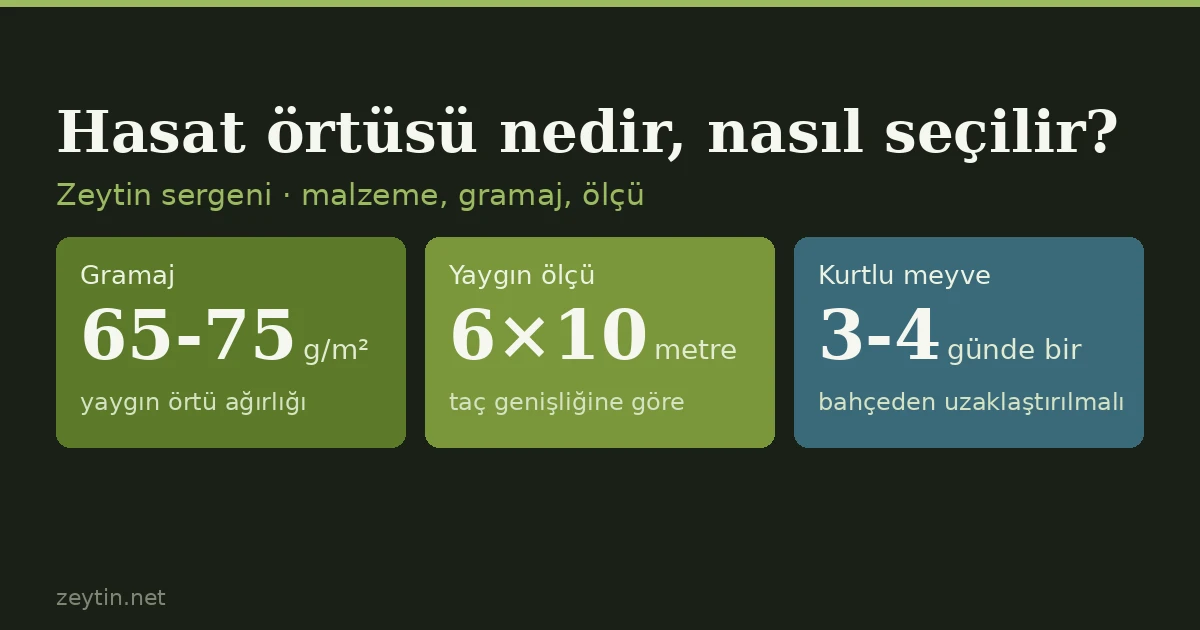
A net spread under the tree does two jobs at once: it keeps the fruit off the soil and it speeds up collection. Olives that touch the ground give higher-acidity oil, and fruit left on the ground feeds the next generation of olive fruit fly. Here is how to choose a net — material, weight, size — and how to lay it.
 Article
Pollination and pollinator varieties in olive
98% of olive flowers drop. Whether the remaining 1-2% holds depends on having a pollinator in the grove. Gemlik is only partially self-fertile: in a single-variety grove harvest falls to a third.
 Article
Arbequina IRTA-i18: the clone behind super-high-density olive groves
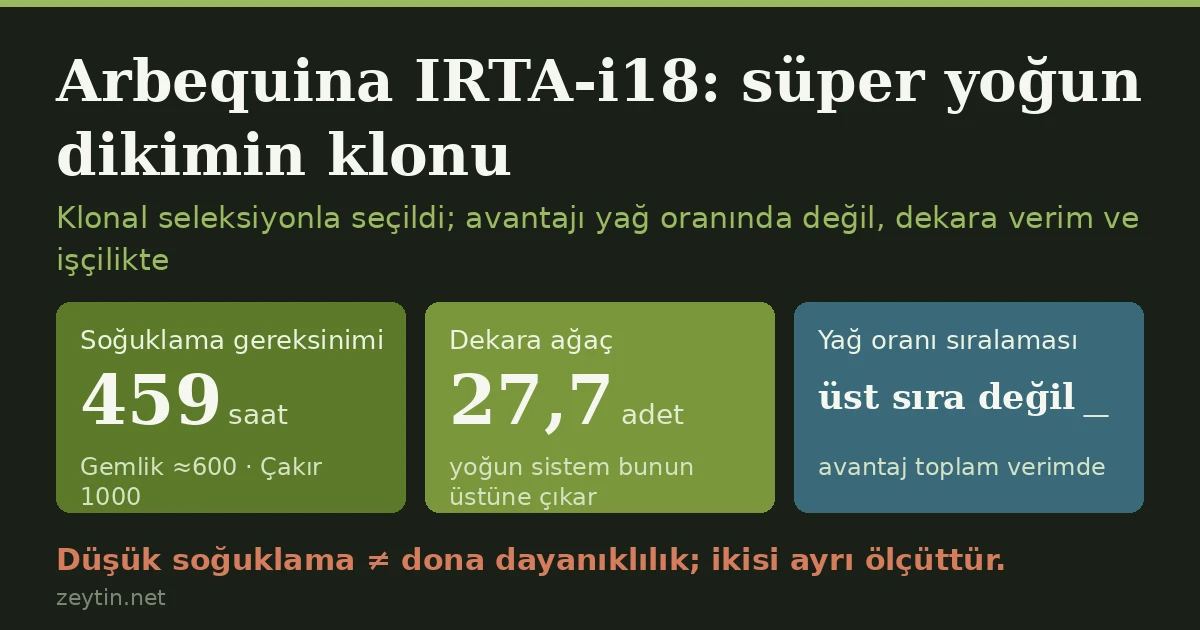
IRTA-i18, developed from Arbequina by clonal selection, was chosen for super-high-density groves. What early bearing, mechanical harvest and a low 459-hour chilling requirement actually mean.