The table olive sector: 461 registered, 8,000 unregistered
Turkey has become the world's leading table olive producer, with a record $255.3m in 2024-25 across 117 countries. Yet only one enterprise in twenty is registered.
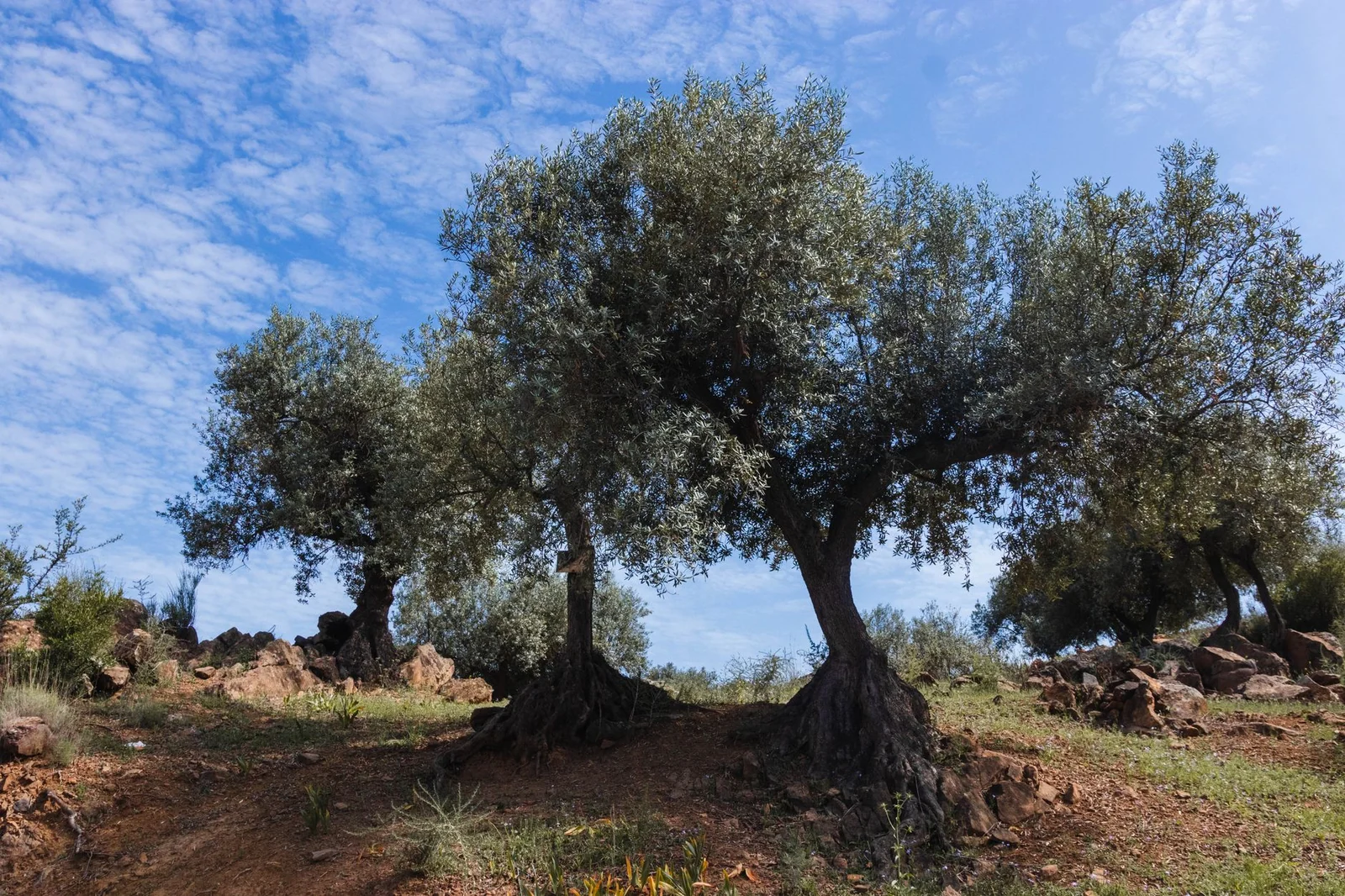
Turkey has become the world's leading producer of table olives for the first time in its history. In the 2024-25 season it earned 255.3 million dollars from table olive exports — the highest figure in the history of the Republic — selling to 117 countries.
Set against the picture the sector's own research institute drew fifteen years ago, that is a large leap. But which of the structural problems identified in that study have been solved, and which are still in place, is a separate question — and the answer is not visible in the production figures.
First, a number: 461 against 8,000
At the time of the study there were, according to official records, 461 table-olive processing enterprises in Turkey.
The number that never entered the records was estimated at around 8,000.
That means of roughly 8,500 units operating in the sector, only one in twenty is registered. Total installed capacity is around 450 thousand tonnes, of which only 40-50% is used.
That single fact explains why the quality-inspection debate is so difficult: most of the enterprises to be inspected are invisible.
This ratio rests on 2010 estimates. Food safety legislation has since tightened and registration efforts have continued; no published measurement of the current level of informality exists. Its value here is in showing the order of magnitude of the problem.
What quality means in a table olive
The standards define table-olive quality by these criteria:
| Criterion | Required |
|---|---|
| Fruit size | homogeneous, uniform |
| Flesh-to-stone ratio | 5-12 : 1 |
| Oil content | low to moderate — around 20% |
| Colour | black: uniform deep black or wine red; green: the shade where green turns to straw yellow |
| Bitterness | completely removed |
| Flesh | must hold its firmness at every stage of processing |
| Stone release | must separate easily from the flesh (essential for stuffing) |
| Skin | thin and elastic — must survive every processing stage |
| Defects | no surface spotting, shrivelling, gas pockets or pest damage |
Sensory quality dominates this list: the consumer judges by appearance, smell, taste and texture.
Where quality is lost
The loss happens not in one place but at four links in the chain: grove and harvest (bruising from
pole harvesting, fruit left in the sun, heating in sacks), pests (Mediterranean fruit fly damage
destroys the commercial value of green table olives outright), processing (concrete tanks, no grading
or sorting, control of pH, salt and yeast) and storage and packaging.
We covered exactly what happens at each of those links in a separate article:
Where is quality lost in table olives?
One point is worth underlining here, because it bears directly on the sector's scale:
t; Once certain forms of spoilage have occurred, there is no remedy.
The only remedy is prevention: observing aseptic rules, removing sediment, controlling pH, keeping surface
yeast in check. And prevention becomes systematic only in an enterprise that can be inspected. In a
structure where one in twenty is registered, that does not hold for most production.
The salt question and exports
Turkish table-olive production uses salt heavily — a long-standing habit.
The consequence: salty olives processed slowly to Turkish taste have poor export prospects. The processed product suits the domestic market more than anything else.
Yet Gemlik, the main variety of the Marmara region that supplies 80% of Turkey's exports, has quality characteristics recognised worldwide. The problem, in other words, is not the variety but the style of processing.
Where the exports went confirmed this for a long time. At the time of the study exports were concentrated in a handful of neighbouring countries:
| Country | Share |
|---|---|
| Romania | 30% |
| Bulgaria | 27% |
| Germany | 9% |
| Iraq | 8% |
| United States | 8% |
| Iran | 3% |
| Australia | 2% |
| Others | 13% |
At the time the source attributed this concentration to those countries being close to Turkish taste and to the Turkish populations living there. Two neighbouring countries alone took more than half of all exports.
Today: 117 countries
The picture is now very different. In the 2024-25 season Turkey shipped black and green olives to 117 countries, with exports setting a record at 255.3 million dollars:
| Item | 2023-24 | 2024-25 | Change |
|---|---|---|---|
| Total revenue | $209m | $255.3m | +22% |
| Black olives | $162m | $194m | +19% |
| Green olives | $47.5m | $61.4m | +29% |
| Volume | — | 100,884 t | 2nd highest ever |
The leading markets have shifted too: Germany, Iraq and Romania for black olives; Iraq, Germany and the United States for green.
What stands out is that green olives are growing faster than black (+29% against +19%) and that the US has entered the top three for green. Green table olives are, as the source notes, the product most vulnerable to Mediterranean fruit fly damage — so the fastest-growing line is also the one carrying the highest quality risk.
There is also this: the sector is targeting 300 million dollars for the 2025-26 season. But once you move from a logic of "countries close to Turkish taste" to 117 countries, every new market brings its own expectations of quality and salt. Export growth sharpens the question of processing style rather than softening it.
The risk of narrowing to Gemlik
Certified-sapling support drove intensive planting of Gemlik, and table-olive plantations expanded rapidly. As those trees come into bearing, production growth is expected to compound.
That carries the familiar risk of production resting on a single variety — the same problem we saw with temperature thresholds and varietal diversity.
What is proposed
The source's recommendations:
1. Quality inspection of enterprises — with the scale of informality kept in view
2. Beyond product support, support for enterprises and exporters that produce quality
3. Closing the shortage of trained staff and intermediate-level extension workers — a shortage described as capable of pushing the sector into a serious bottleneck
4. Sending technical staff to high-consumption countries to learn consumer profiles
5. Promotional work in countries where consumption has not yet started but population and consumption habits suggest potential
What stands out in this list is that most of the recommendations concern not technology but people: those who inspect, process, teach and promote.
Sources
- Savran, M.K. & Demirbaş, N. (2011) — The Quality Problem in the Table Olive in Turkey and Some Suggestions, Journal of the Agricultural Faculty of Uludağ University, 25(2): 89-99
- Tetik, H.D. (2005, 2006) — Table-olive processing techniques and factors affecting quality
- Aktan, N. & Kalkan, H. (1999) — Table Olive Technology, Ege University
- Marsilio, V. (2002) — Sensory analysis of table olives, Olivae 90
- Aegean Exporters' Associations / AA (2025) — 2024-25 season table olive export figures
- TS 774 Table Olive Standard · Turkish Food Codex Table Olive Communiqué (2008/24)
One rating per visitor; you can change yours at any time. Ratings are real reader votes — no seeded or default scores.
Related
 Article
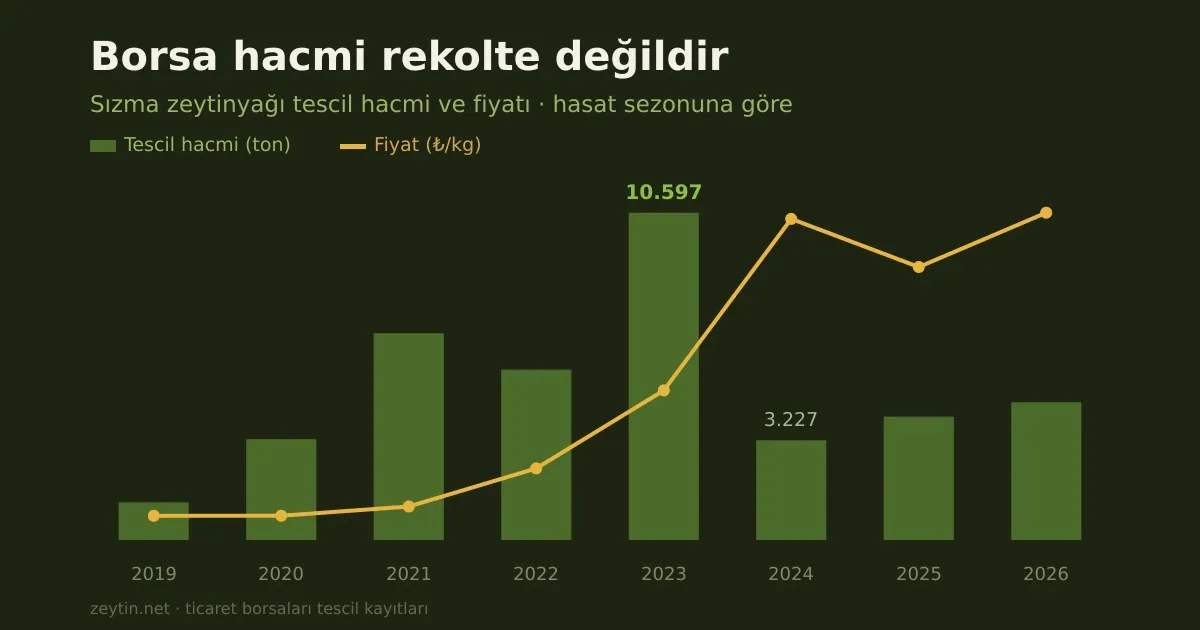
Exchange volume is not the harvest: what the 2023 record actually recorded
10,597 tonnes registered in 2023, down to 3,227 the next season. Harvest collapse or a change of channel? The data cannot tell them apart.
Article
Exchange volume is not the harvest: what the 2023 record actually recorded
10,597 tonnes registered in 2023, down to 3,227 the next season. Harvest collapse or a change of channel? The data cannot tell them apart.
 Article
Kilis: the structure is solved, the soil is not
Kilis is the one place in south-eastern Anatolia to have finished the institutional job: a union, an integrated plant, a geographical indication. Yet 100% of 49 soil samples are iron-deficient.
Article
Kilis: the structure is solved, the soil is not
Kilis is the one place in south-eastern Anatolia to have finished the institutional job: a union, an integrated plant, a geographical indication. Yet 100% of 49 soil samples are iron-deficient.
 Article
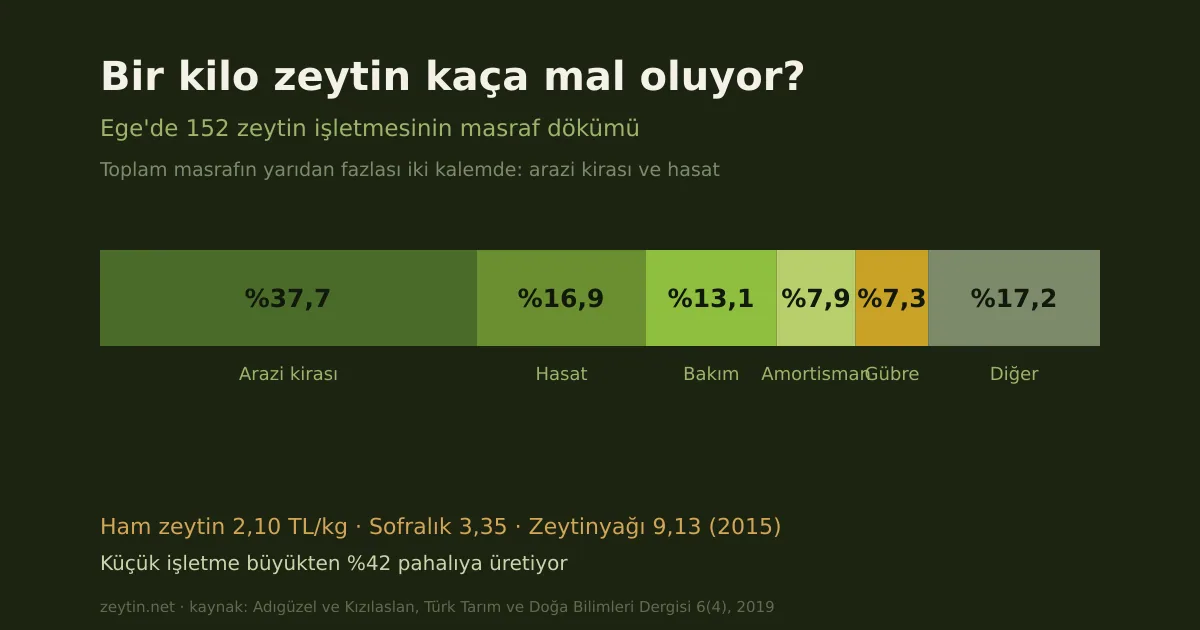
What does a kilo of olives cost? The cost sheet of 152 Aegean farms
Land rent is 37.70% of cost, harvest 16.90%. In table olives 73% of processing cost is rejected fruit; in oil, 94% is the fruit itself.
Article
What does a kilo of olives cost? The cost sheet of 152 Aegean farms
Land rent is 37.70% of cost, harvest 16.90%. In table olives 73% of processing cost is rejected fruit; in oil, 94% is the fruit itself.
 Article
Rain in Andalusia, prices in Aydın: how Spain's drought set the price in Türkiye
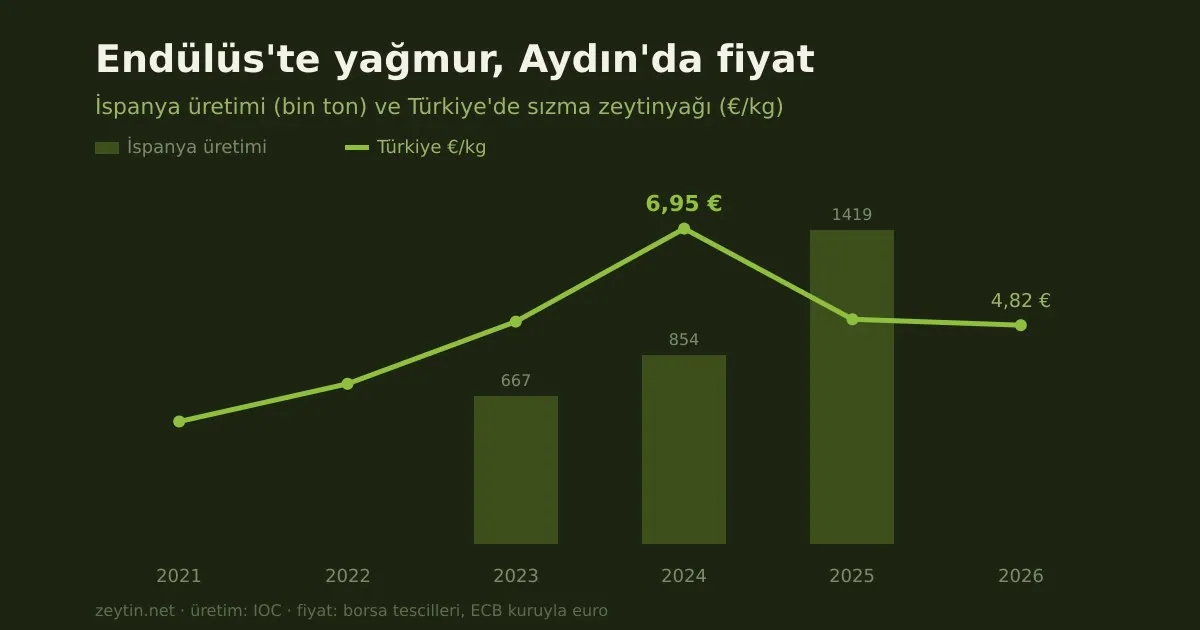
Spain makes 40% of the world's olive oil. Its output halved in 2022/23 and Türkiye's euro price went from €2.70 to €6.95.
Article
Rain in Andalusia, prices in Aydın: how Spain's drought set the price in Türkiye
Spain makes 40% of the world's olive oil. Its output halved in 2022/23 and Türkiye's euro price went from €2.70 to €6.95.