Does a harvesting machine damage the olive tree?
Trunk shakers, branch shakers and hand picking: the damage comes not from the machine itself but from its settings and duration. The figures the Turkish agriculture ministry's research institute gives for the Gemlik variety — 70 bar clamping pressure, 20 Hz, a 6-8 second shake — and what falls off the tree once that window is exceeded. Why grove spacing, slope limits and operator training are technical requirements.
The first question from any grower moving to mechanical harvesting is always the same: will it damage my trees? The answer lies not in the type of machine but in three numbers — clamping pressure, vibration and shaking duration. Get those right and the machine stresses the tree less than hand picking does; get one wrong and the damage scales with the machine.
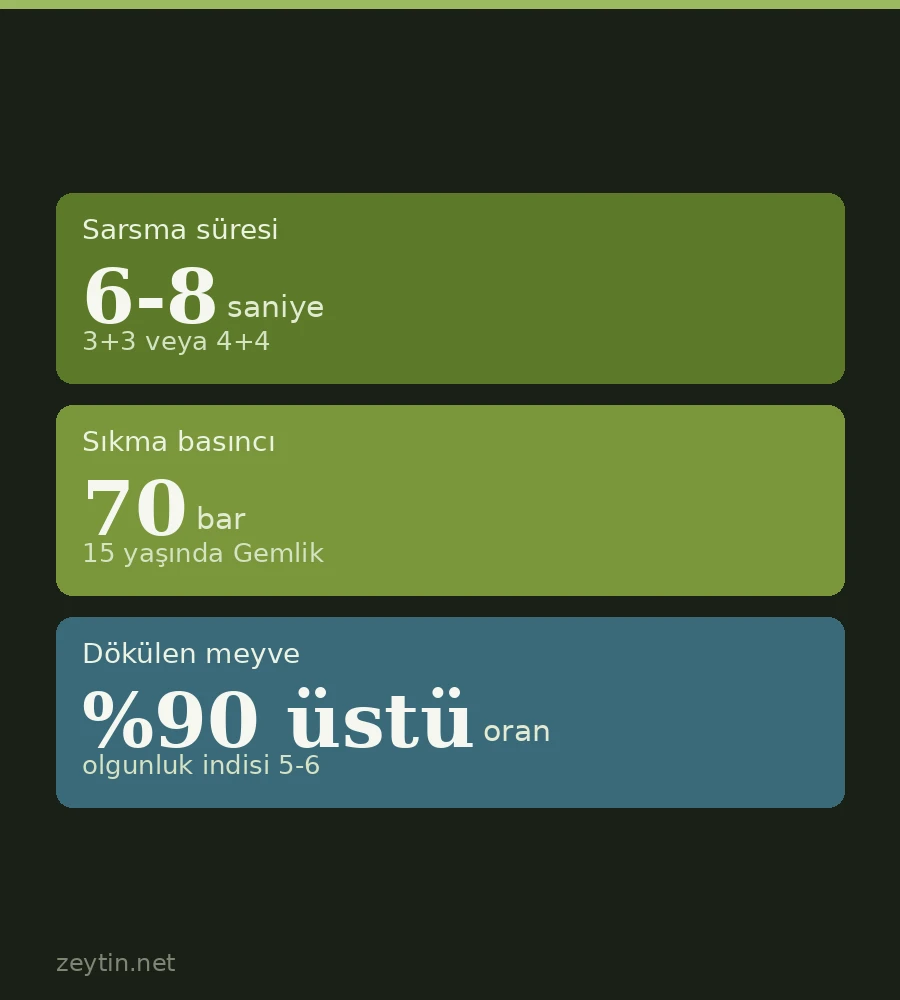
The mechanical harvesting publication of the Atatürk Central Horticultural Research Institute in Yalova, part of Turkey's Ministry of Agriculture and Forestry, gives these figures with the variety and tree age stated. The values below are for 15-year-old Gemlik trees.
Where damage begins: after the eighth second
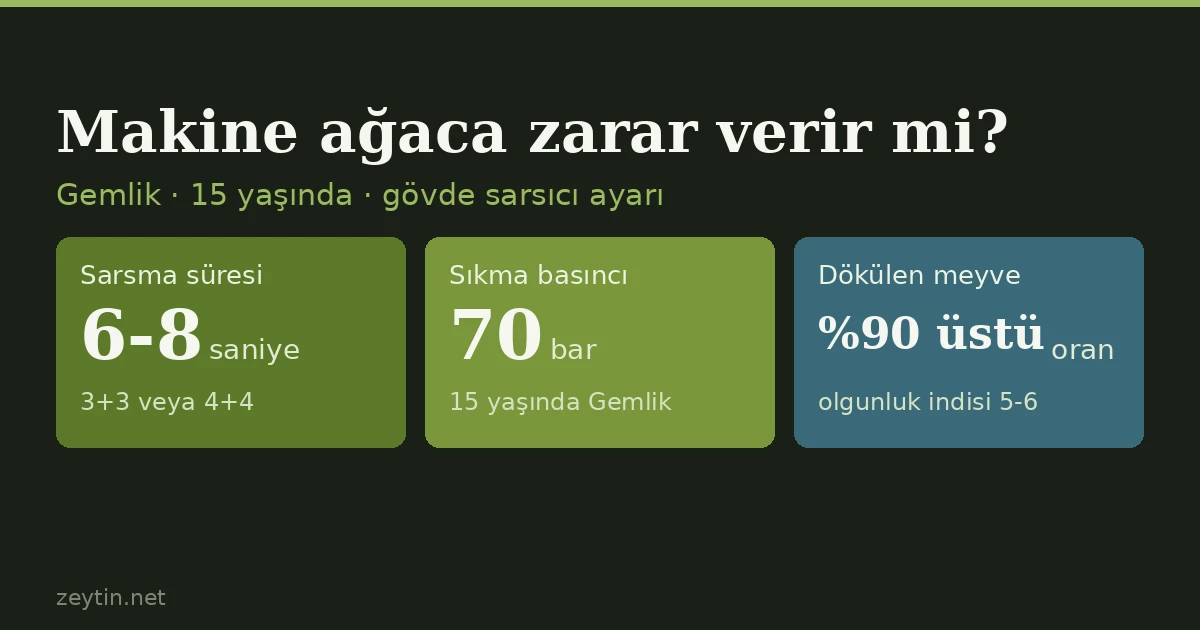
A self-propelled trunk shaker, in the hands of a skilled operator and with the correct settings, removes more than 90 percent of the fruit from a tree that has reached harvest maturity with an eight-second shake. Depending on conditions, six seconds can be enough.
The critical sentence comes next: shaking longer does not bring down more fruit. Past that point, what starts falling is shoots, leaves and branches. The institute's publication states the consequence plainly: those fallen shoots, leaves and branches reduce the following year's crop and cause alternate bearing — the on-year, off-year pattern.
The reason lies in how the olive fruits. Olive bears its crop on one-year-old shoots. The thin shoot torn off today is next season's fruiting position. Damage to the tree therefore does not show up in that day's harvest; it appears a year later as a missing crop.
A practical rule follows: manage the shaking time by fruit fall, not by the clock. The institute's warning is explicit — fruit fall should be watched and harvesting stopped immediately. The "just a few more seconds" reflex means borrowing from next year in this crop.
Measured values for Gemlik
| Trunk shaker settings (15-year-old Gemlik) | Value |
|---|---|
| Clamping pressure | 70 bar |
| Vibration frequency | 20 Hz |
| Amplitude | 20-60 mm |
| Shaking duration | 6-8 seconds (3+3 or 4+4) |
| Fruit removed | more than 90% |
The duration is written as "3+3" or "4+4": not one continuous shake but two short ones. These values are variety- and age-specific. Seventy bar is a pressure given for the trunk of a 15-year-old Gemlik. On a younger, thinner trunk the same pressure can crush the bark, and on a very old, hollowed trunk there may be no suitable clamping point at all.
The institute stresses another point: if the machine is not carefully adjusted, the trunk itself can be damaged, which is why the operator of a trunk shaker must be a very well-trained expert. Operator training here is not a courtesy but a technical requirement.
The hidden condition behind the 90 percent
The trunk shaker's "removes more than 90 percent of the fruit" performance is not unconditional. The institute's sentence specifies a tree that has reached harvest maturity. Unripe fruit holds firmly to its stem; the same share will not come off the same tree in the same time. The operator's first reflex is then to extend the shake — and that is exactly where the damage enters.
The institute also gives the maturity criterion: olives should be harvested at stage 5-6 on the maturity index. Harvesting earlier or later degrades the quality of the crop and causes a loss of economic value. Maturity can also be classified visually from a cross-section of the fruit.
In mechanical harvesting, in other words, the date decision and the settings decision are tied together. Enter the grove before maturity and the shaker looks inadequate; the problem is in the calendar, not the machine.
Why a branch shaker can do more harm
Intuition says the opposite: a branch shaker is small, it never touches the trunk, it looks gentler. The institute's description says otherwise.
Harvesting with a branch shaker takes a little less time than hand picking, but fruit left inside the canopy and in the upper sections still has to be picked by hand. Not every branch can be gripped. Operator carelessness leads to some branches being damaged, and in trying to shake every olive off the branch being held, the shoots are damaged too. The outcome lands in the same place: damaged branches and shoots reduce the following year's crop.
There is also the operator side. Working with trunk and branch shakers exposes the operator to noise, vibration and dust; with branch shakers, complaints affecting the hands, internal organs and the spine are reported. Choosing a machine is a decision about human health as well as tree health.
Hand picking is not "harmless"
This is the point most often skipped in the comparison. The institute's publication also records the cost of hand harvesting: it spreads over a long period, and picker errors together with the equipment used — poles, combs and the like — damage the tree's shoots and branches and so affect the following year's crop.
A quality detail is added to that: bare-handed picking destroys the bloom, the waxy layer on the fruit's surface. That layer is precisely what buying companies prefer. The method considered the gentlest can therefore erase a feature the table-olive buyer looks for. We compared all the methods in the harvesting methods article.
The machine makes demands on the grove, not the tree
The real constraint of a trunk shaker is not the tree but the layout of the grove. Fallen fruit can be collected on sheets spread on the ground, but an umbrella system gives safer and gentler collection. Umbrella manoeuvring requires that the spacing between and within rows be planned accordingly: the institute gives an acceptable range of at least 7×7 m or 8×7 m.
If an existing grove lacks that spacing, the options narrow to two — work with ground sheets, or switch to the tractor-mounted form. Tractor-mounted trunk shakers have difficulties with manoeuvrability and control functions in densely planted groves. The self-propelled form has advantages because it has a cab, a steering arrangement and controls within the operator's reach, and it works comfortably on land with a slope of up to 15 percent.
So why use a machine at all?
Because the gap closes in hourly income. In a study reported by the institute, net income relative to the main harvest period was calculated as ₺713 per hour for a trunk shaker, ₺411 per hour for a branch shaker and ₺27 per hour for hand picking. The lira amounts belong to the period of the study and should not be read as today's prices. The ratio, however, speaks: the trunk shaker's hourly net income is roughly 26 times that of hand picking, the branch shaker's about 15 times.
The other half of the matter is the calendar. The Gemlik harvest traditionally begins on 29 October, and in that window rain, mud and cold hit both the crop and the workers. Compressing the harvest from days into hours directly shortens one of the biggest causes of quality loss — fruit waiting before it reaches the mill.
The short answer
With the correct pressure and frequency, a 6-8 second shake and a trained operator, a harvesting machine does no lasting damage to the tree and takes more than 90 percent of the fruit. Damage comes from three places: exceeding the duration (shoot and leaf loss), pressure that does not match the variety and age (trunk wounds) and an untrained operator. All three are properties of the use, not of the machine.
One rating per visitor; you can change yours at any time. Ratings are real reader votes — no seeded or default scores.
Related
 Article
Irrigating Olives: When, How Much, How
Olive water requirements, critical periods, drip system layout, deficit irrigation and water quality.
Article
Irrigating Olives: When, How Much, How
Olive water requirements, critical periods, drip system layout, deficit irrigation and water quality.
 Article
When to harvest olives: deciding with the maturity index
Harvest timing is set by the maturity index, not the calendar. The 0-7 colour scale, how to calculate it from 100 fruits, early versus late harvest compared, and ripening times by variety.
Article
When to harvest olives: deciding with the maturity index
Harvest timing is set by the maturity index, not the calendar. The 0-7 colour scale, how to calculate it from 100 fruits, early versus late harvest compared, and ripening times by variety.
 Article
Organic olive growing: what a four-year trial found
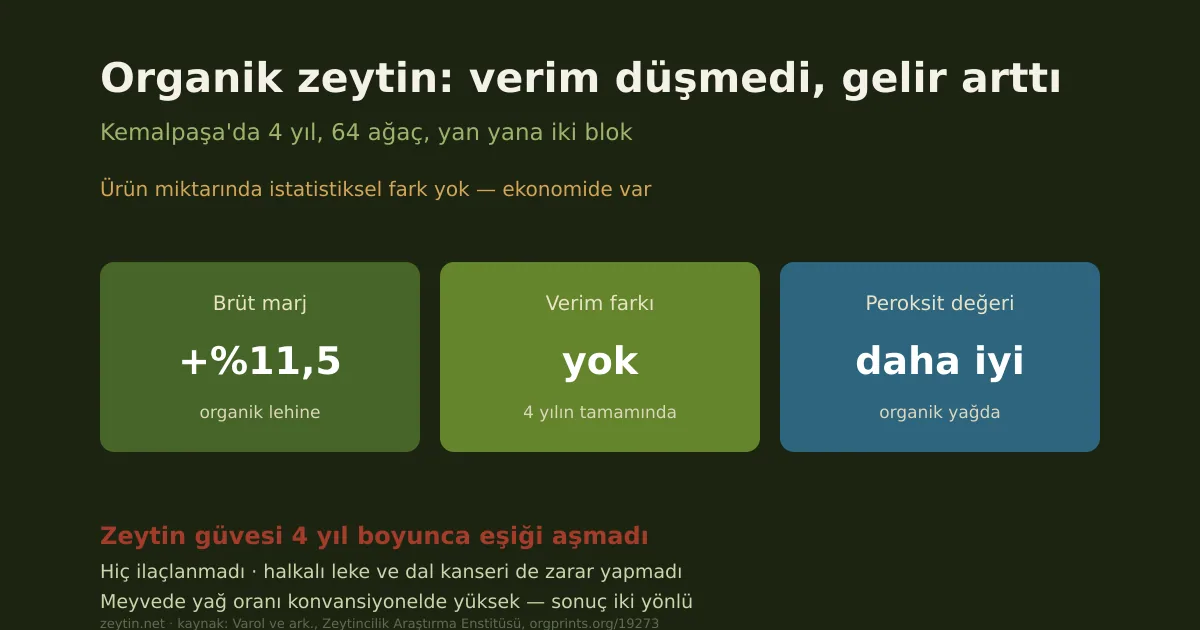
A four-year organic vs conventional trial at Kemalpaşa: no yield difference, 11.5% higher gross margin for organic, lower peroxide value, but higher fruit oil content under conventional management.
Article
Organic olive growing: what a four-year trial found
A four-year organic vs conventional trial at Kemalpaşa: no yield difference, 11.5% higher gross margin for organic, lower peroxide value, but higher fruit oil content under conventional management.
 Article
Why is my olive tree not bearing fruit? 9 causes and what to do
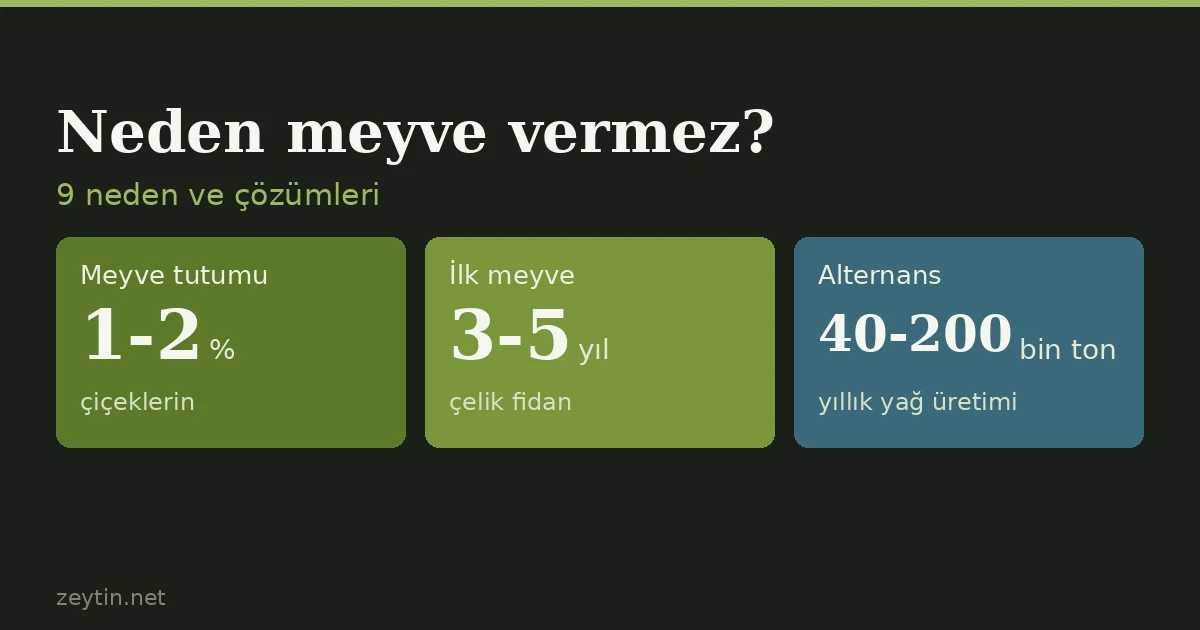
Behind an olive tree that flowers but sets no fruit, fills one year and stays empty the next, or has never cropped at all, there is usually more than one cause. From the tree's age and lack of grafting to missing pollinators, insufficient chilling, drought and the wrong fertiliser or pruning, here is how to diagnose by symptom and what to do.
Article
Why is my olive tree not bearing fruit? 9 causes and what to do
Behind an olive tree that flowers but sets no fruit, fills one year and stays empty the next, or has never cropped at all, there is usually more than one cause. From the tree's age and lack of grafting to missing pollinators, insufficient chilling, drought and the wrong fertiliser or pruning, here is how to diagnose by symptom and what to do.