Can you put olive oil on your skin? What the evidence says
You can, but studies suggest regular use may weaken the skin barrier; it is not advised for eczema or babies and gives no sun protection.
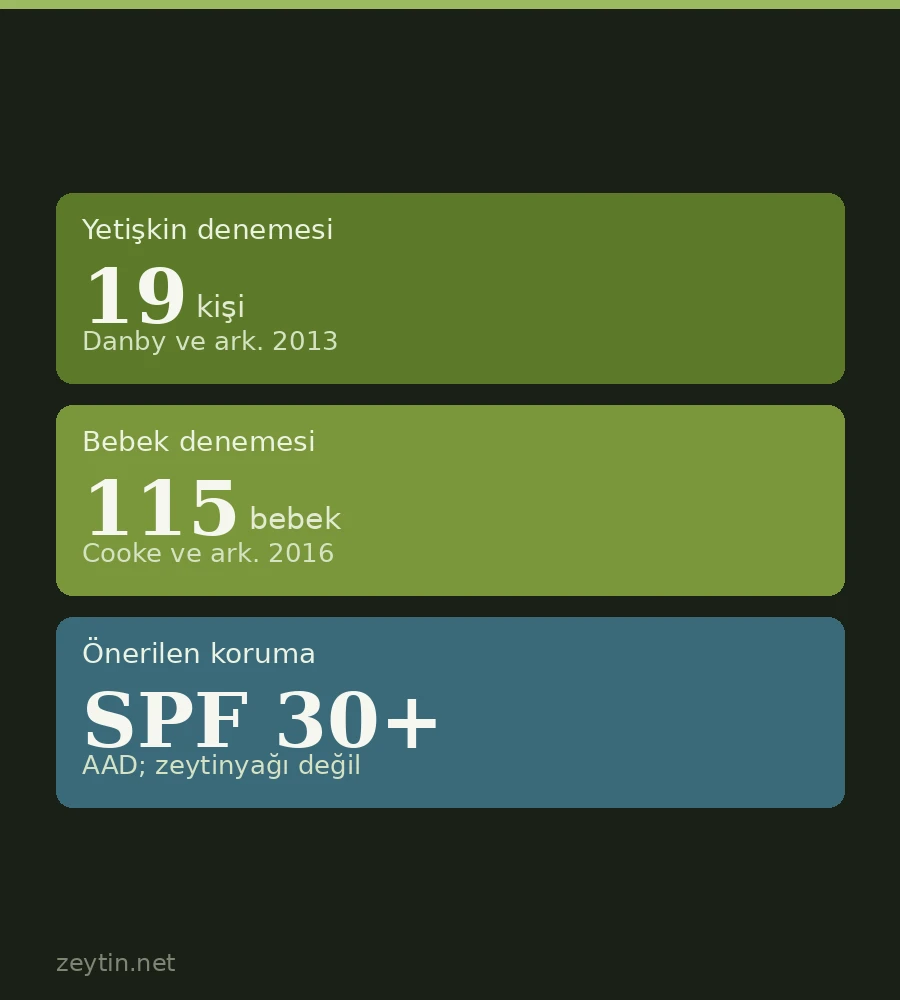
You can put it on your skin, but it helps to know what the evidence says first. Olive oil leaves a thin film on the surface and makes skin feel softer almost straight away. Peer-reviewed studies, however, suggest that regular use can weaken the skin barrier, and the UK's National Eczema Society no longer recommends it. Its sun protection is close to zero. In short, olive oil is a valuable food, but on current evidence it is not a good moisturiser.
Does olive oil moisturise the skin?
In one sense, yes. Oil forms a film over the stratum corneum, the outermost layer of the skin, and slows the evaporation of water for a while. In a 2016 pilot trial in newborns, babies who had olive oil applied showed higher skin hydration readings than babies who had no oil.
Hydration is not the whole story, though. The protective work of the skin is done by ordered layers of lipids packed between the cells. That structure is what really holds water in and keeps microbes and allergens out, and it is exactly where the question mark over olive oil appears.
What did skin barrier studies find?
Two studies stand out. Both come from the UK and from the same research network.
Danby and colleagues, 2013 (Pediatric Dermatology). Nineteen adult volunteers, with and without a history of atopic dermatitis, applied oil to their forearms twice a day. The first group used olive oil alone for five weeks. The second compared olive oil and sunflower seed oil on opposite forearms for four weeks. Olive oil significantly reduced stratum corneum integrity and caused mild redness. Sunflower seed oil preserved integrity, caused no redness and improved hydration. The authors advised against using olive oil to treat dry skin or for infant massage.
Cooke and colleagues, 2016 (Acta Dermato-Venereologica). In the OBSeRvE pilot trial, 115 healthy full-term babies were randomised to olive oil, sunflower oil or no oil. The oils were applied twice daily for four weeks. Hydration improved in both oil groups, but the structure of the skin's lipid layers developed less than in the no-oil group. There were no significant differences in water loss, skin pH or redness. The authors noted that the trial was not powered to measure clinical outcomes and called for caution in recommending oils for newborn skin until more research is done.
| Study | Participants | Duration | Finding for olive oil |
|---|---|---|---|
| Danby et al. 2013 | 19 adults | 4–5 weeks, twice daily | Reduced barrier integrity, mild redness |
| Cooke et al. 2016 | 115 newborns | 4 weeks, twice daily | Better hydration, lipid layer development behind the no-oil group |
Both studies are small, and neither proves that olive oil causes eczema. But they point in the same direction, and they are the best data available today.
Why did olive oil and sunflower oil behave differently?
The difference may come down to fatty acid make-up. The dominant fatty acid in olive oil is oleic acid. Under the International Olive Council (IOC) trade standard, oleic acid makes up between 55 and 83 per cent of olive oil. Sunflower oil, by contrast, is dominated by linoleic acid.
Oleic acid has long been known to loosen the ordered lipid layers of the skin. The cosmetics and pharmaceutical industries use this very property to help other substances pass through the skin. Danby and colleagues propose this mechanism to explain why olive oil weakened the barrier. Linoleic acid, meanwhile, is one of the building blocks of the skin's own ceramides. This is a proposed explanation rather than a settled conclusion.
The fatty acid and vitamin profile that makes olive oil worthwhile in food and the way it behaves on skin are separate matters. Oleic acid eaten as part of a meal and oleic acid spread on the skin do not act in the same way.
Should olive oil be used on eczema or dry skin?
Here the position of patient organisations is clear. On its scalp eczema page, the National Eczema Society states that "olive oil is no longer recommended as it has been found to damage the skin barrier", and its seborrhoeic dermatitis page says the same. Its page on complementary therapies adds that olive oil is no longer recommended as a carrier oil for aromatherapy oils either. For dry skin and eczema, the recommended approach is the liberal and frequent use of emollients designed to support the barrier, chosen with a doctor or pharmacist.
Is it safe to rub olive oil on a baby?
Rubbing babies with olive oil is a common tradition in Turkey and around the Mediterranean. A study of olive oil in Turkish folk medicine by Melike Kaplan and Seda Karaöz Arıhan records practices such as wiping a baby with warmed and cooled oil against nappy rash, and massaging babies with oil. That work documents tradition; it does not measure whether the practices work.
The only trial that took measurements is the 2016 pilot described above, and because of its findings the researchers do not recommend applying olive oil to newborn skin. That caution matters even more for babies at higher risk of eczema, for example when there is a family history of atopy.
Does olive oil help you tan, or protect you from the sun?
Olive oil does not speed up tanning and does not protect against the sun. The figure that circulates online, an SPF of about 8 for olive oil, comes from a 2010 laboratory study by Kaur and Saraf in Pharmacognosy Research. The oils were diluted in a mixture of alcohol and water, and their absorption of ultraviolet light was measured in a spectrophotometer. That is a screening measurement, not a test on human skin, and the authors themselves describe the method as a supplement to in vivo SPF testing rather than a replacement for it.
A 2021 study by Martiniaková and colleagues in Photochemical & Photobiological Sciences re-measured 14 vegetable oils in the laboratory and tested the five most heavily promoted ones on volunteers' skin. The authors wrote that the dilution method is fundamentally flawed for substances with such negligible photoprotection as most vegetable oils. Values measured on human skin ranged from 1.2 to 2.8. Olive oil was not among those five. An SPF of 1 means no protection at all.
For comparison, the American Academy of Dermatology (AAD) recommends a broad-spectrum, water-resistant sunscreen of at least SPF 30. According to the AAD, a tan is itself a sign that ultraviolet light has damaged the skin. For people who want a bronzed look, the AAD suggests a self-tanning product, still used together with sunscreen. Oiling up and lying in the sun is no substitute for that protection.
Does putting olive oil in the belly button do anything?
Social media posts claim that a few drops of oil in the navel can improve digestion, skin or hormones. We could not find a single peer-reviewed study that tested this claim. The belly button is simply skin, and there is no known mechanism or measurement showing that oil placed there reaches internal organs or has any effect on them. It may be a harmless habit, but it is not a health treatment.
Which olive oil is used in cosmetics?
The food grades (extra virgin, virgin, riviera) describe flavour and chemical quality. Extra virgin is not necessary for applying to skin. Its main advantage, polyphenols, matters when the oil is eaten; there is not enough clinical data on what they do on the skin.
The oldest and most solid link between olive oil and skin is soap. Once the oil is saponified with sodium hydroxide it is no longer an oil but a fatty acid salt that cleans and is rinsed off rather than left on the skin. We cover the story of Aleppo, Castile and Marseille soap in the history of olive oil soap, and how to choose a genuine bar in our olive oil soap guide.
So what should you do?
There is no evidence that a healthy adult does any harm by occasionally using olive oil to remove make-up or soften a dry elbow. As a regular moisturiser, on skin with eczema and on newborn skin, however, the evidence does not favour olive oil, and it is no replacement for sunscreen. For a long-standing skin problem, ask a dermatologist which products to use.
One rating per visitor; you can change yours at any time. Ratings are real reader votes — no seeded or default scores.
Related
 Article
What Is the Mediterranean Diet?
Not a weight-loss plan but a pattern of eating. The basics of the Mediterranean way of eating, recognised by UNESCO, and where olive oil sits within it.
 Article
Which olive is healthiest?
In olives the health difference comes from curing and salt, not the variety: nutrition, salt content and green vs black.
 Article
Benefits of Olive
The nutritional profile of olives, polyphenols and salt content. No unauthorised health claims — only verifiable information, with sources.
 Article
How Much Olive Oil a Day?
Olive oil being healthy does not make it unlimited. A practical look at portions, calories and the logic of replacement.