Two thirds of our exports are table olives: the $260 million picture
In 2025-26, 66% of exports were table olives and 27% oil. Average unit value $3.17/kg — the added value sits inside the packaging.
Say olives in Türkiye and people think of olive oil. The sector talks about itself in the same terms: harvest, milling, yield, extra virgin. Look at the export figures, though, and a different picture appears.
In the 2025-2026 season, two thirds of Türkiye's olive and olive oil exports were table olives. Olive oil accounted for a little over a quarter.
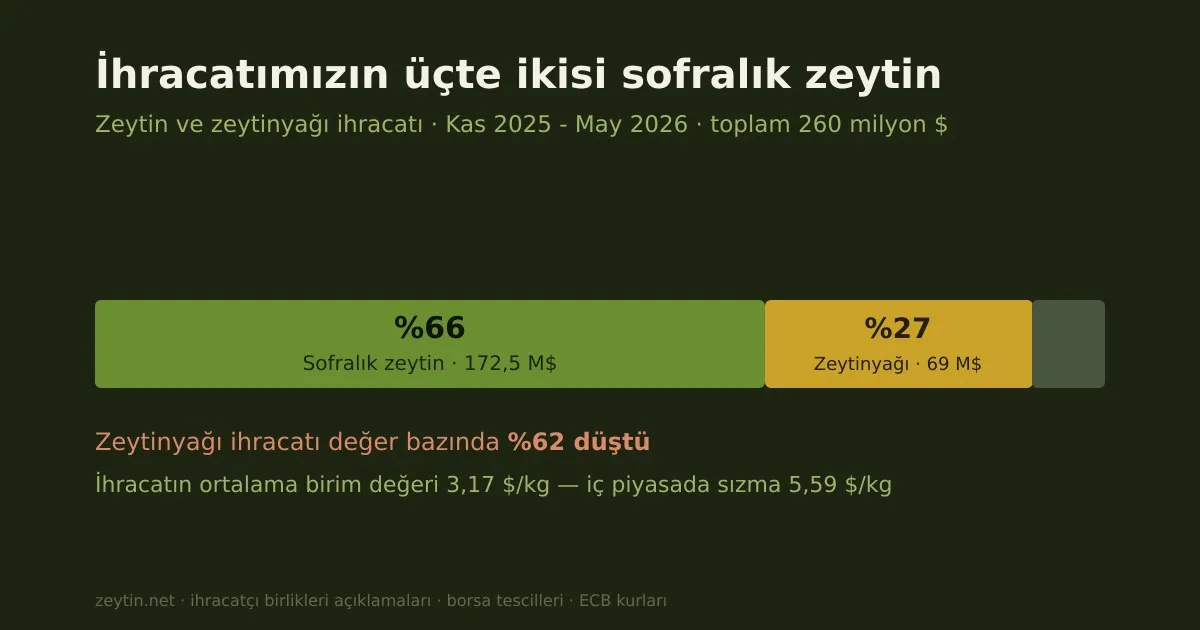
It is one of the least discussed and most revealing numbers in the sector.
The table
| Item | Value | Share |
|---|---|---|
| Total exports | $260 million | 100% |
| Table olives | $172.5 million | 66% |
| Olive oil | $69 million | 27% |
| Other (pomace etc.) | $18.5 million | 7% |
Source: press records based on statements by the Aegean Olive and Olive Oil Exporters' Association and TİM. Total exports fell 34% against the same period of the previous season; olive oil exports fell 62% by value.
That 62% fall in olive oil is the main source of the 34% fall in the total. Table olives held up comparatively well; the item that collapsed was oil.
$3.17 per kilogram
Over the first half of 2026 Türkiye exported roughly 59,000 tonnes of olives and olive oil for $187 million. Divide one by the other and you get the number at the centre of this whole discussion:
$3.17 per kilogram.
Over the same period, extra virgin olive oil registered on Turkish exchanges at 249.44 lira per kilogram; at the period's average rate of 44.64 TL/$, that is $5.59.
So the average unit value of exports is a little over half the domestic price of olive oil. There is only one explanation: most of those 59,000 tonnes was not olive oil but table olives, which sell for far less per kilogram.
Why do table olives hold up better?
The difference between how table olives and oil behave in export markets is structural, not accidental.
Table olives are already packaged. They are exported in tins or vacuum packs, branded or unbranded, in a form that reaches the consumer directly. There is a layer of processing on top of the product, and its price is not tied purely to the raw material.
Olive oil largely leaves in bulk. In bulk trade the price reference is Spain, and a buyer will switch countries over a few cents. When Türkiye's domestic price rises, that trade stops.
There is less direct competition in table olives. Spain, Egypt and Türkiye are the main players, and the product differentiates by variety, size and preparation. A Gemlik olive is not a like-for-like substitute for a Spanish Manzanilla. Bulk extra virgin olive oil has no such differentiation — chemically the same product, one price.
The conclusion: the added value is inside the packaging. Türkiye earns two thirds of these exports from a packaged product, and that was the item that survived the downturn.
The other half of the story
Olive oil exports did not fall 62% because the product got worse. They fell because the price is not competitive.
We measured this in detail separately: Is Turkish olive oil cheap? In thirteen of fourteen months Türkiye's bulk extra virgin price sat above Spain's; in June 2026 the gap reached 23%.
For a buyer the calculation is simple: if the same standard of product is cheaper from Spain, they do not buy from Türkiye. Turkish oil finds demand mainly in years when Spain has nothing to sell — as in 2023.
Falling exports are therefore not a quality problem but a price positioning problem. And what holds the price up is strong domestic demand.
Is this good or bad?
Both.
The good: growers can sell at home above the world price. For farm income that matters more than the export figure. Exporting is a channel, not a goal; if a better-paying channel exists, producers use it, and there is nothing wrong with that.
The bad: dependence on the domestic market is fragility. If domestic demand weakens, or an abundant harvest pulls prices down, you need an external channel to move the surplus. Such channels stay open only through continuous use; a supplier who appears and disappears by season does not stay on buyers' lists.
Industry representatives expect one of the largest harvests on record in 2026-2027 and aim to bring exports back to the $1 billion band. An abundant harvest pulling domestic prices down could make that possible — but the price growers receive would fall with it. The two goals do not hold at once.
What geographical indications are for
Being packaged is not enough on its own; the product also needs an identity. Türkiye's instrument here is geographical indication registration.
Registrations like Gemlik olives, Ayvalık olive oil, Milas olive oil and Nizip olive oil record legally that a product belongs to a particular area and is made by that area's methods. For a buyer that is an assurance; for a producer, a means of differentiation.
The economic value of registration is not automatic. A geographical indication reaches the price only if it is enforced, marketed and recognised by consumers. Otherwise it stays on paper. Marks like Toscano IGP or Kalamata PDO command a premium in Europe not because of the registration itself but because of decades of control and promotion behind it.
Türkiye's number of registrations is far from negligible; what is missing is how well those marks are known in export markets. It is an equation partly solved for table olives and not yet solved for oil.
Two prices for the same oil
The clearest illustration of the logic in the table is this.
Bulk extra virgin trades at roughly $5.59 per kilogram on the exchange. A branded, GI-marked bottle on a European shelf sells for several times that per litre.
The difference does not come from the oil. It comes from the bottle, the label, the brand, that brand being on the shelf, and the consumer knowing the name. The oil is the same oil.
The way for Türkiye to raise export earnings is not selling more tonnes but moving the same tonnes to the stage where they are worth more. In table olives part of that has been achieved; olive oil is still standing at the first link of the chain.
Limits
The export figures here are compiled from press records based on exporters' association and TİM statements; they are not primary data we collect. Price and exchange rate figures come from our own series: exchange registrations and ECB daily rates.
The periods do not overlap exactly: the export breakdown covers the November-May season, while the tonnage and dollar figures cover the first half of 2026. The unit value should therefore be read as an order of magnitude, not a precise unit price.
There are also large price differences within each category: branded bottles and bulk drums fall under the same heading. Our breakdown cannot separate them.
Summary
- In 2025-2026, 66% of exports were table olives and 27% olive oil.
- Olive oil exports fell 62% by value — the main source of the overall decline.
- Average export unit value was $3.17/kg against a domestic extra virgin price of $5.59/kg.
- Table olives held up because they are packaged and differentiated; bulk oil is pure price competition.
- Falling exports are a price positioning problem, not a quality problem.
Related reading: Is Turkish olive oil cheap? · From olive to oil: the price gap · The olive sector
One rating per visitor; you can change yours at any time. Ratings are real reader votes — no seeded or default scores.
Related
 Article
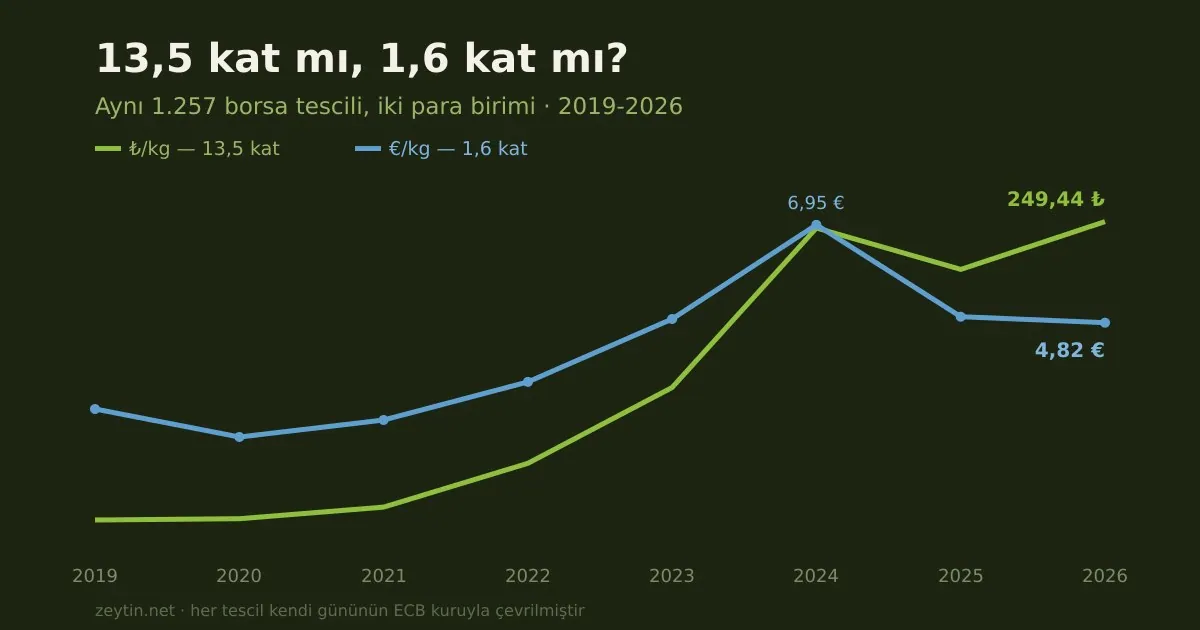
Did olive oil go up 13.5 times, or 1.6 times?
Up 13.5 times in lira, 1.6 times in euros. The same 1,257 registrations, each converted at its own day's ECB rate.
Article
Did olive oil go up 13.5 times, or 1.6 times?
Up 13.5 times in lira, 1.6 times in euros. The same 1,257 registrations, each converted at its own day's ECB rate.
 Article
How to read olive oil exchange prices
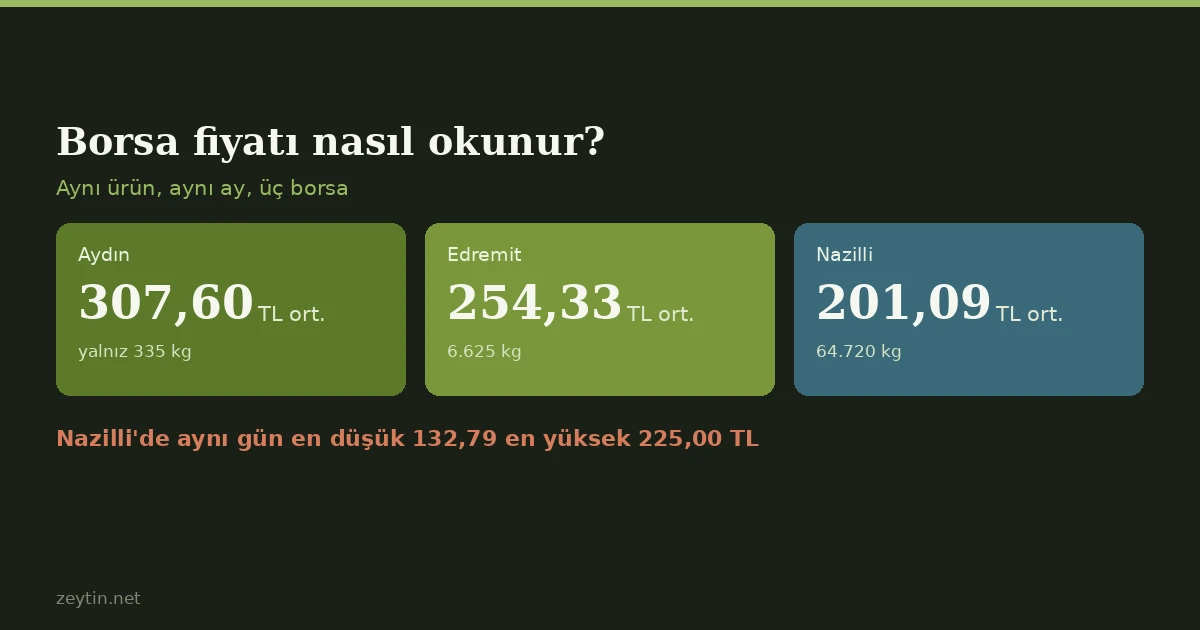
Three exchanges, three averages for the same product: 201, 254 and 308 lira. In Nazilli, trades from 132.79 to 225.00 in a single day. What an exchange price measures, and why date and volume matter more than the average.
Article
How to read olive oil exchange prices
Three exchanges, three averages for the same product: 201, 254 and 308 lira. In Nazilli, trades from 132.79 to 225.00 in a single day. What an exchange price measures, and why date and volume matter more than the average.
 Article
A demand for 50 lira per litre: what the numbers say
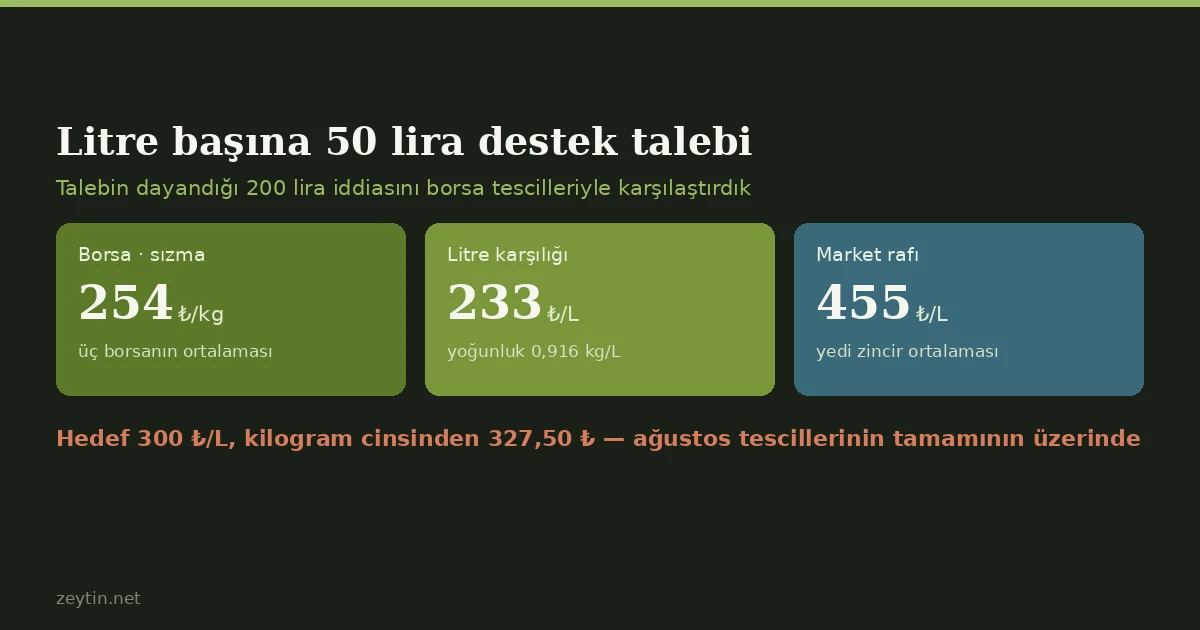
The Edremit Chamber of Commerce has called for at least 50 lira per litre in support for olive oil producers. We check the price claim behind that demand against registered exchange trades.
Article
A demand for 50 lira per litre: what the numbers say
The Edremit Chamber of Commerce has called for at least 50 lira per litre in support for olive oil producers. We check the price claim behind that demand against registered exchange trades.
 Article
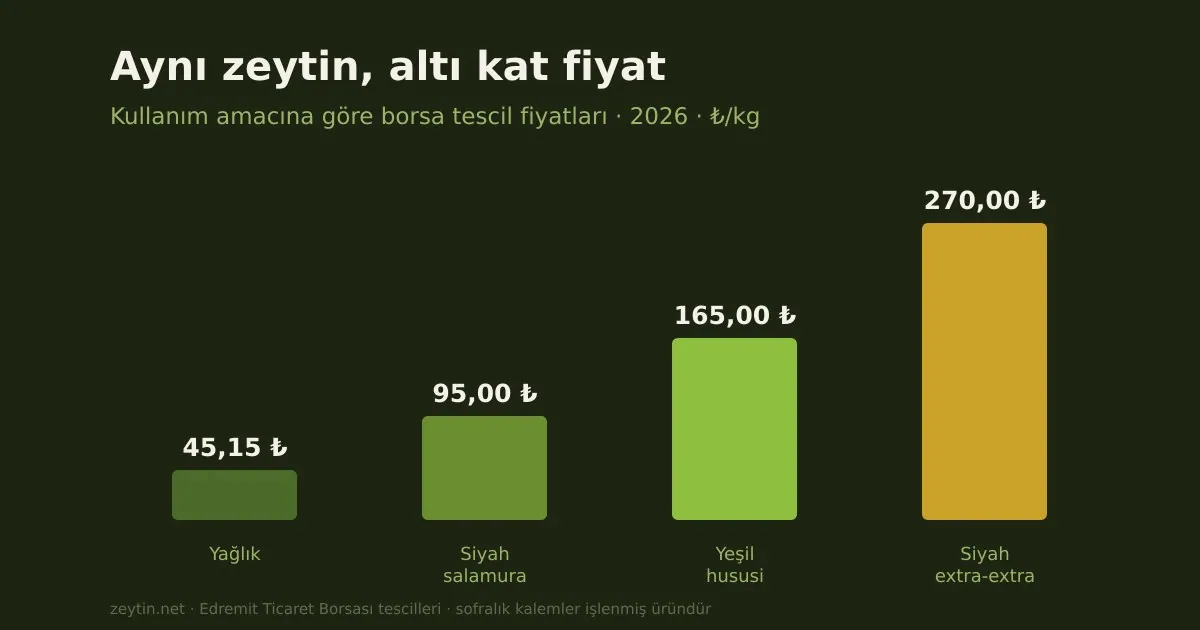
The same olive, six times the price: the quiet advantage of table olives
How much more does the same fruit fetch as a table olive than for oil? Measured over seven years of exchange data: 1.43 to 3.46 times.
Article
The same olive, six times the price: the quiet advantage of table olives
How much more does the same fruit fetch as a table olive than for oil? Measured over seven years of exchange data: 1.43 to 3.46 times.